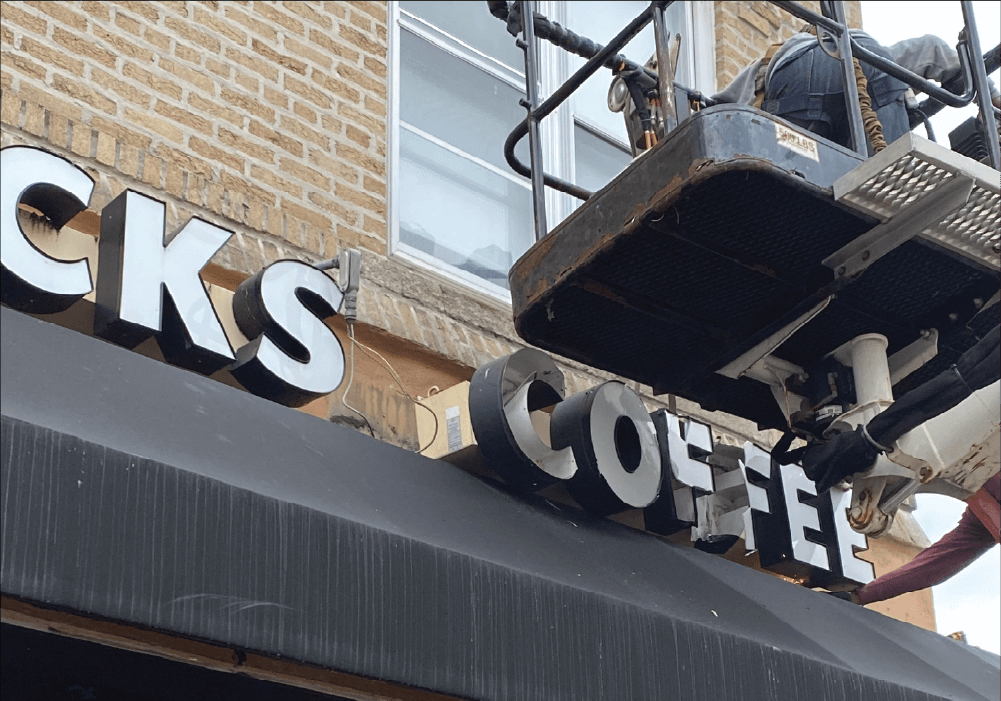
Taking down channel letters is the easy part. The power, the holes and the shadow they leave behind decide the real cost.
When a business closes, moves or rebrands, removing an old business sign is usually the tenant’s job, with the property owner as the backstop. In practice the answer comes from two documents read together: the lease, which says who pays and what condition the wall must be left in, and the town’s sign ordinance, which says how long a dead sign may stay up and who the town will chase if it does.
Most disputes start when nobody reads either document until the moving truck has left. The sign stays up for months, the fascia is full of holes when it finally comes down, and the cost lands on whoever is easiest to reach.
This guide covers who is responsible, the deadlines some New Jersey towns set, what changes in New York City, and what a proper removal includes so the wall is ready for the next tenant.
Who Is Responsible at a Glance
| Situation | Usually responsible | Where the rule comes from |
|---|---|---|
| Tenant leaves at the end of a lease | Tenant removes the sign and restores the fascia | Lease surrender or restoration clause |
| Tenant leaves the sign behind | Property owner, who then recovers the cost | Lease, security deposit, town ordinance |
| Business closes but still owns the building | Owner of the business and the building | Town abandoned sign rule |
| Rebrand at the same location | Business owner, as part of the new sign project | New sign permit and lease approval |
| Sign is unsafe or damaged | Owner of the sign, then the property owner | Construction official’s authority over unsafe signs |
What the Lease Usually Says
Most commercial leases treat a tenant’s sign as the tenant’s property and the tenant’s problem. A typical clause requires the tenant to remove its signs before the lease ends, repair any damage the installation or removal caused, and return the storefront to the condition it was in at the start. Shopping center leases often go further and name the patching method, the paint finish and who may do the work.
Where the lease is silent, the tenant still owns the sign, but the landlord is the party the town will hold responsible once the business is gone. That is why many landlords hold part of the security deposit until the fascia has been inspected.
When the Tenant Leaves the Sign Behind
An abandoned sign does not stay the tenant’s problem for long. The landlord usually has to remove it before the space can be leased again, then tries to recover the cost from the deposit or the departing tenant. Keeping photographs of the storefront on move in day and move out day makes that recovery far easier.
When the Landlord Wants the Sign Kept
Sometimes the new tenant or the owner wants to reuse the cabinet, the raceway or the pylon panel. That is a perfectly reasonable outcome, but it should be agreed in writing, because a sign left in place by agreement is very different from a sign left behind by default. Our retail center sign requirements guide covers how pylon panels are usually handled.
What New Jersey Towns Require
Town codes set the outside limit for how long a dead sign may stay up after a business stops operating. The deadlines vary a lot, so the specific municipality matters.
- Franklin Township: a sign must be removed within 30 days after the business stops operating or vacates, under § 112-108C of the township code.
- Bridgewater Township: a business that closes has 90 days after notice to remove its signs, under § 126-195F of the land use code.
- Other towns: many ordinances group abandoned signs with unsafe or nonconforming signs and let the zoning or construction official order removal, then bill the property owner if nobody acts.
For any other municipality, the clause to look for is usually titled abandoned signs, discontinued use or obsolete signs. Larger cities set their own rules too, from sign work in East Orange to Elizabeth business signs, so read the clause for the exact address before the lease ends.
The Construction Official Can Step In
Under the New Jersey Uniform Construction Code, the construction official keeps the authority to require removal of any sign that creates an unsafe condition, even one that never needed a permit, as set out in N.J.A.C. 5:23-2.14. A loose letter, a cracked face or an exposed wire after a tenant has gone is exactly the kind of condition that gets reported.
What Changes in New York City
In New York City the same lease logic applies, but the physical work is more regulated. The Construction Code makes it unlawful to hoist, lower, hang or attach a sign on the outside of a building unless a licensed sign hanger does the work or directly supervises it, with exemptions that include signs of up to 75 square feet and 25 pounds. Taking a large sign down counts as lowering it.
Illuminated signs that project beyond the building line, such as lit blade signs, also carry an annual illuminated sign permit that the owner is billed for until it is closed out, which is a good reason to deal with a dead projecting sign promptly. The Department of Buildings explains both on its sign permit page.
- Deadlines set town by town
- Construction official can order unsafe signs removed
- Electrical disconnect by a licensed electrical contractor
- Pole and monument removal needs an 811 markout before digging
- Licensed sign hanger for signs over 75 sq ft or 25 lbs
- Annual illuminated sign permit runs until closed out
- Sidewalk work may need its own approvals
- Landmark buildings need care with masonry repair
What a Proper Removal Includes
Pulling letters off a wall takes an afternoon. Leaving the wall ready for the next sign is the part that is usually underestimated, and it is the part leases are written about.
- Disconnect the power safely: an illuminated sign is fed by its own circuit. In New Jersey the Board of Examiners of Electrical Contractors treats electrical contracting as a single licensed trade, so disconnecting and capping the feed is work for a licensed electrician, not the moving crew.
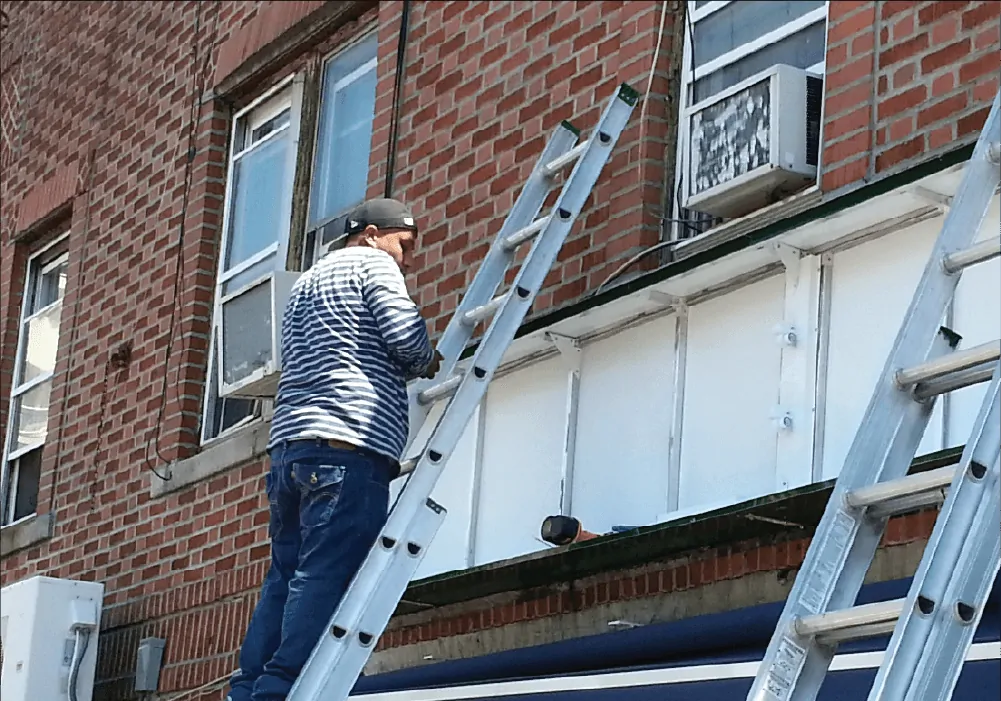
- Remove letters, cabinet or raceway: channel letters come off one at a time, while light box cabinets and raceways come off as a unit and often need a lift.
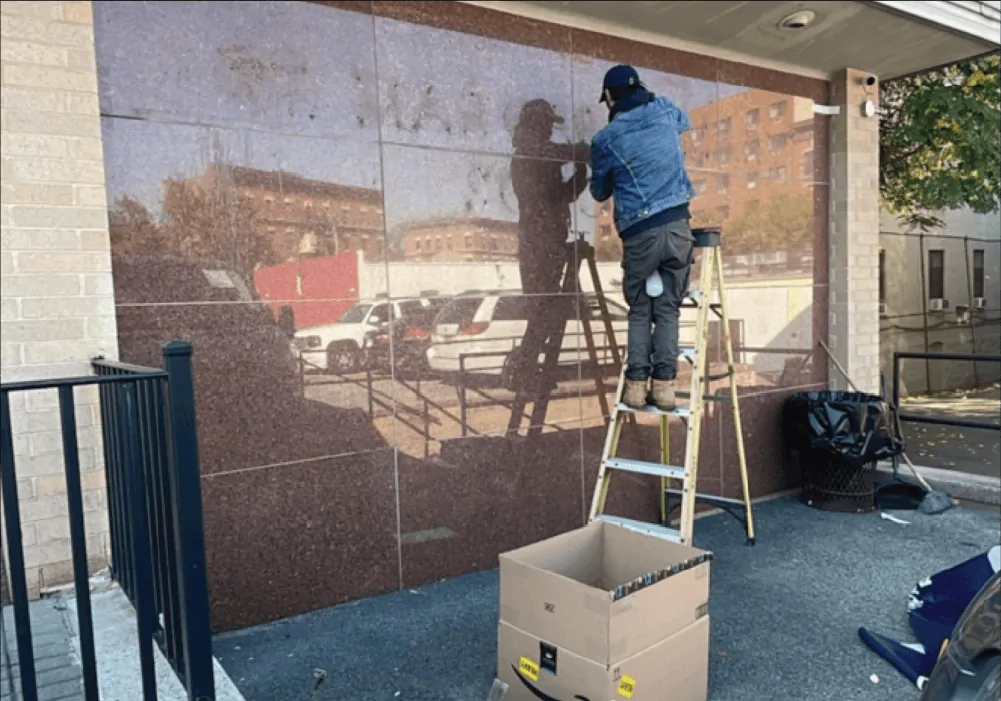
- Deal with the penetrations: every letter leaves fastener holes and a wire hole. On masonry these are filled with matching mortar or patching compound, on metal fascia they are sealed against water.
- Treat the ghosting: years of sun leave a clean outline where the old letters sat. Painted fascia usually needs a full repaint of the band, not a spot repair, or the old name stays readable.
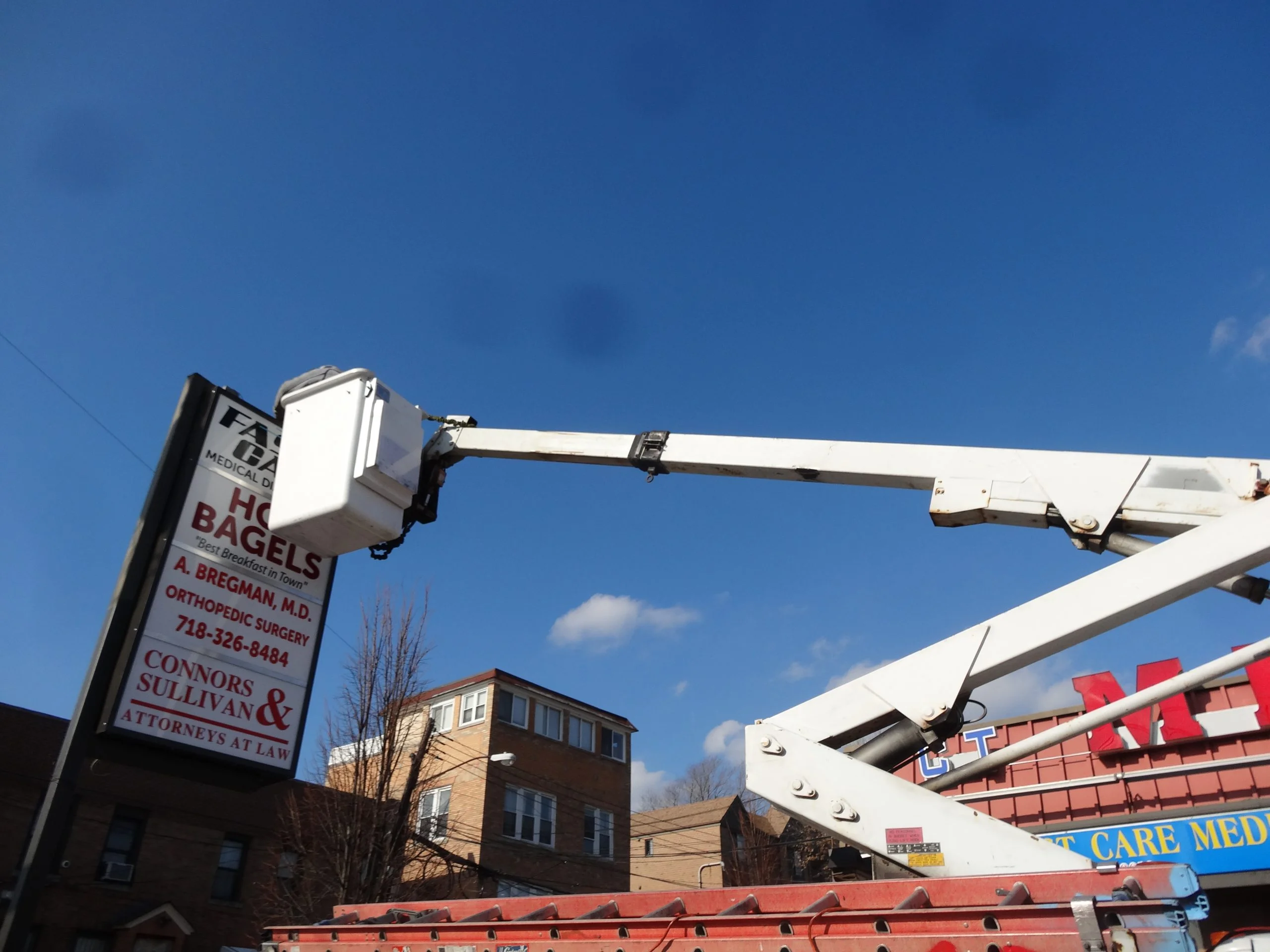
- Remove freestanding signs properly: a pole or monument sign has a foundation and usually an underground feed. New Jersey law requires a call to New Jersey One Call (811) before excavation so buried utilities are marked first.
- Recycle and record: aluminium returns and steel cabinets are recyclable. Photographs of the finished wall close the file for both the landlord and the tenant.
Removal During a Rebrand
When the business is staying and only the name or logo is changing, removal becomes part of the new project. The old sign comes down the same day the new one goes up, so the storefront is never blank, and the new letters can often be positioned to reuse the existing wire hole.
It is also the moment to check whether the old sign was ever permitted. A replacement sign generally needs its own approval, and an unpermitted predecessor can complicate that application. See our NJ and NYC sign permits page for how filing is handled, and the guide on rebranding without replacing every sign for cases where a reface is enough.
How Landlords and Tenants Can Avoid the Dispute
The simplest protection is a clear clause written before the sign goes up, not after the tenant has gone. Property managers who set this out in their tenant signage guidelines rarely end up paying for someone else’s sign.
- Name the deadline: removal before the lease ends, or within a fixed number of days of vacating, whichever comes first.
- Name the standard: holes filled, band repainted to match, electrical feed capped at a junction box.
- Name who does the work: an insured sign company, with a licensed electrician for the disconnect.
- Keep records: approved drawings, the permit number and photographs from installation day.
Common Questions About Removing an Old Business Sign
Does the tenant have to remove the sign when the lease ends?
In most cases, yes. Commercial leases usually require the tenant to remove its signs and restore the fascia, and town codes back that up with a deadline once the business stops operating. If the lease is silent, the landlord is often left to do it and recover the cost.
Can the landlord keep the deposit for sign removal?
Usually, if the lease allows deductions for restoration and the tenant left the sign or damaged the wall. Dated photographs of the storefront at move in and move out are what make the deduction stick.
Do I need a permit to take a sign down?
It depends on the sign and the place. Disconnecting an illuminated sign is electrical work that may need its own permit, and in New York City a large sign must be lowered by or under a licensed sign hanger. Ask the local construction office before removing a pole or monument sign.
How long can an abandoned sign stay up in New Jersey?
There is no single state deadline. Each town sets its own, commonly somewhere between 30 and 90 days after a business closes or after notice. Check the abandoned sign section of the town’s code.
What does sign removal usually include?
A proper job includes a safe electrical disconnect, removal of the letters or cabinet, sealing every hole, repainting the sign band so no ghost image remains, and photographs of the finished wall. A quote that only says remove sign may leave the patching to you.
Can the old sign be reused by the next business?
Sometimes. Cabinets, raceways and pylon structures can often be refaced for a new tenant if they are sound and the landlord agrees. Letters spelling the old name are rarely reusable.
Plan Your Sign Removal
Gogi Signs removes old signs across New Jersey and New York City, from single letter sets to pylon panels, and leaves the wall ready for whatever goes up next. We coordinate the electrical disconnect, patch and repaint the fascia, and photograph the finished storefront for your records.
See our Sign Removal page for what the service covers, or request a free quote with a photo of the sign and we will tell you what the job involves.