A sign in the right place does half the work of the design. In the wrong place, even a perfect sign goes unseen.
Exterior sign placement decides whether customers ever get the chance to read the sign. A well designed sign mounted too high, hidden behind a tree, blocked by an awning or set back too far from the road loses most of its value, and moving it later means new holes, new wiring and often a new permit.
Placement is also where design meets the rules. Towns limit how high a sign may be, how far it may project over the sidewalk and how far back a freestanding sign must sit, and accessibility rules protect people walking underneath.
This guide covers how to choose the position, the clearances and limits that apply, and how to fix the sign to the building properly.
Placement Rules at a Glance
| Placement question | What to aim for | Rules that commonly apply |
|---|---|---|
| Where customers approach from | Visible from the main approach, early enough to act | None, but it drives every other choice |
| Wall sign height | Within the sign band, below the second floor | Height caps, roofline limits |
| Projecting sign clearance | Clear headroom above the sidewalk | Minimum clearance and maximum projection |
| Sidewalk safety | Nothing at head height a cane cannot detect | ADA protruding object limits |
| Freestanding sign position | Clear of driveway sightlines and traffic signals | Setbacks, height caps, spacing |
| Fixing to the wall | Into sound structure with durable hardware | Some codes specify the hardware |
Start With the Approach
Before choosing a spot on the wall, stand where customers come from. Walk the sidewalk in both directions, drive the road from each side and note the point where someone needs to see the sign to turn in or walk in. Then note what blocks the view from that point: trees, awnings, columns, utility poles, neighbouring signs and parked trucks.
For drivers, the best position is usually the part of the facade or lot that faces oncoming traffic most directly. On busy highway corridors such as Route 1 in Edison and Woodbridge, or Route 17 in Paramus, that point comes early, because drivers need time to change lanes. See our Edison sign company, Woodbridge sign services and Paramus business signs pages for those corridors. For pedestrians, who look along the street rather than at the building, a projecting sign or window graphic often works better than a wall sign alone. Our guide to designing signs for different viewing distances explains how distance and speed set the letter height.

Wall Signs: Use the Sign Band
Most storefronts have a sign band, the horizontal strip of wall above the windows and below the second floor, and it is the natural home for storefront channel letters or a light box sign. It is where customers expect to look, it keeps the sign in proportion with the building and it is usually where the town expects the sign to be.
Towns put limits around it, usually a minimum height above grade and a maximum below the second floor. Atlantic City, for example, does not allow wall signs above the roofline of the wall they are on. Center the sign over the entrance or the storefront, keep consistent margins and line it up with neighbouring signs where the center has a common band.
Corner Units
A corner or end unit has two elevations that face traffic. Some towns allow a second sign on the side elevation, Old Bridge and Brick among them, but usually at a separate size limit. Check before designing both.
Projecting and Blade Signs
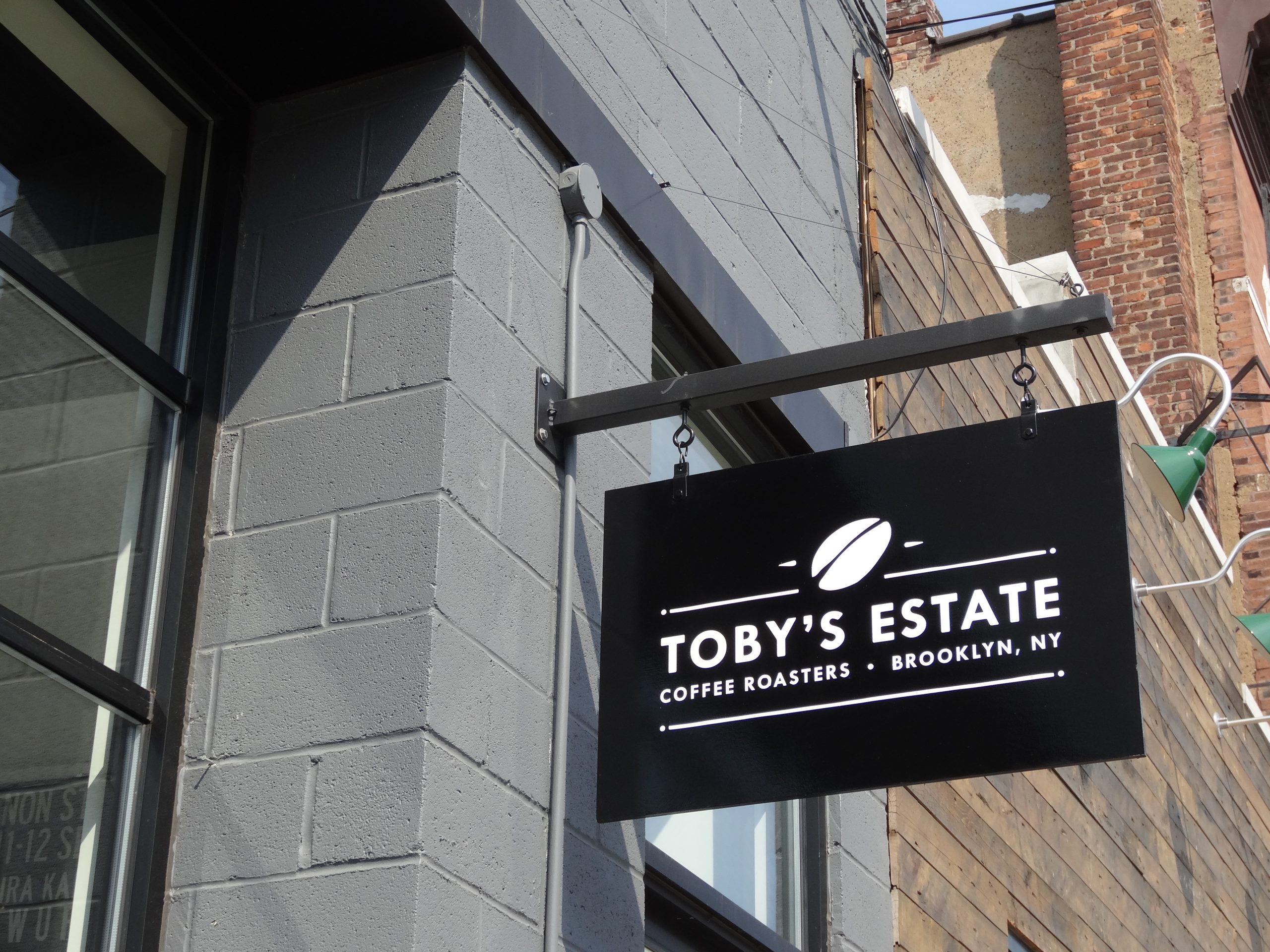
Projecting signs reach pedestrians looking along the sidewalk, but they hang over a public walkway, so clearances matter most here.
- Atlantic City: no more than 4 feet from the wall, at least 2 feet back from the curb, at 90 degrees to the building, not off a corner and at least 8 feet above grade.
- Old Bridge: up to 4 square feet, at least 8 feet above the sidewalk, projecting no more than 3 feet.
- New York City: the Zoning Resolution generally limits signs in commercial districts to 18 inches beyond the street line for double faced signs and 12 inches for others, under Section 32-652, with exceptions in some districts.
See our blade and projecting signs page for bracket and cabinet options.

Keep the Sidewalk Safe
Anything mounted on a wall beside a walkway also has to respect accessibility rules. Under the 2010 ADA Standards, an object whose leading edge is between 27 and 80 inches above the ground may protrude no more than 4 inches into the path, because a person using a cane cannot detect it. Objects above 80 inches or below 27 inches are not limited in this way. Signs on posts or pylons may overhang the path by no more than 12 inches within that height band. The U.S. Access Board’s guide to protruding objects illustrates each case.
In practice, that means wall mounted signs at eye level along a sidewalk should be flat to the wall, and projecting signs should clear 80 inches at their lowest point. Most town codes go further, asking for 7 or 8 feet of clearance.
Freestanding Signs: Setbacks and Sightlines
Monument and pylon signs carry the most placement rules, because they sit near driveways and roads.
- Setbacks: Old Bridge requires freestanding signs to sit at least 10 feet from the street right of way or 20 feet from the pavement, whichever is greater, and some towns scale the setback with the size of the sign.
- Height: East Brunswick measures freestanding sign height from the centerline of the street in front, so a site above the road has less usable height.
- Spacing: East Brunswick requires a new freestanding sign to sit at least 100 feet from an existing one next door.
- Traffic signals: Marlboro and East Brunswick prohibit red, green or yellow lights within 100 feet of a traffic signal, so drivers do not confuse a sign with the signal.
Keep monument signs out of the driver’s sight triangle at the driveway, where they could hide oncoming traffic. Our shopping center sign rules guide covers pylon panels in multi tenant centers.

Fix the Sign Properly
Where the sign goes on the wall is also a structural decision. The fixings need to reach sound material, avoid weakening the facade and resist wind and water.
- Find what is behind the fascia: many storefront fascias are thin panels over a frame, and the sign must be fixed through to structure or to blocking added behind.
- Use durable hardware: stainless or galvanized fixings that will not stain or corrode. Old Bridge’s code, for example, requires drilled holes with non rusting expansion hardware on masonry and bans wood or fiber plugs.
- Fix into mortar where possible: on masonry, fixing into the joints is easier to repair later than drilling through the brick face.
- Plan the power route: an illuminated sign needs a wire hole and a junction box behind the sign, ideally reusing an existing penetration.
- Seal every penetration: water entering through fixing holes damages both the wall and the sign.
Our Sign Installation page explains how we survey and fix signs to different wall types.
- Height, projection and setback set town by town
- Projecting signs commonly need 8 ft of clearance
- Freestanding signs set back from the right of way
- Colored lights restricted near traffic signals in some towns
- Projection beyond the street line limited by zoning
- Commonly 18 in for double faced, 12 in for others
- Licensed sign hanger for larger signs
- Landmark buildings need design review before fixing
Common Questions About Exterior Sign Placement
How high should a storefront sign be mounted?
Usually in the sign band above the windows and below the second floor, where customers expect to look. Many towns set limits, such as at least 8 feet above grade and no higher than the second floor sill.
How low can a projecting sign hang over a sidewalk?
Most codes require at least 7 or 8 feet of clearance. Accessibility rules also limit anything between 27 and 80 inches above the ground to 4 inches of protrusion, so projecting signs should always clear 80 inches.
How far can a sign project in New York City?
Under the Zoning Resolution, signs in most commercial districts may extend up to 18 inches beyond the street line if double faced and 12 inches otherwise, with exceptions in certain districts. A permit is usually required.
Where should a monument sign go?
Near the entrance and facing oncoming traffic, but outside the required setback and clear of the driveway sightline so it does not hide traffic from exiting drivers.
Can I put my sign on the roof?
Many towns prohibit roof signs outright, and others restrict signs above the roofline. Check the ordinance before considering it.
Does a corner store get two signs?
Sometimes. Several towns allow a second sign on the side elevation of a corner or end unit, usually with its own size limit. The lease may also have something to say.
Find the Right Spot for Your Sign
Gogi Signs surveys every site before final drawings, checking sightlines from the approach, clearances, the town’s limits and what is behind the wall, so the sign goes where it works and stays where it is fixed.
See our Site Survey page, or request a free quote with photos taken from where your customers approach.