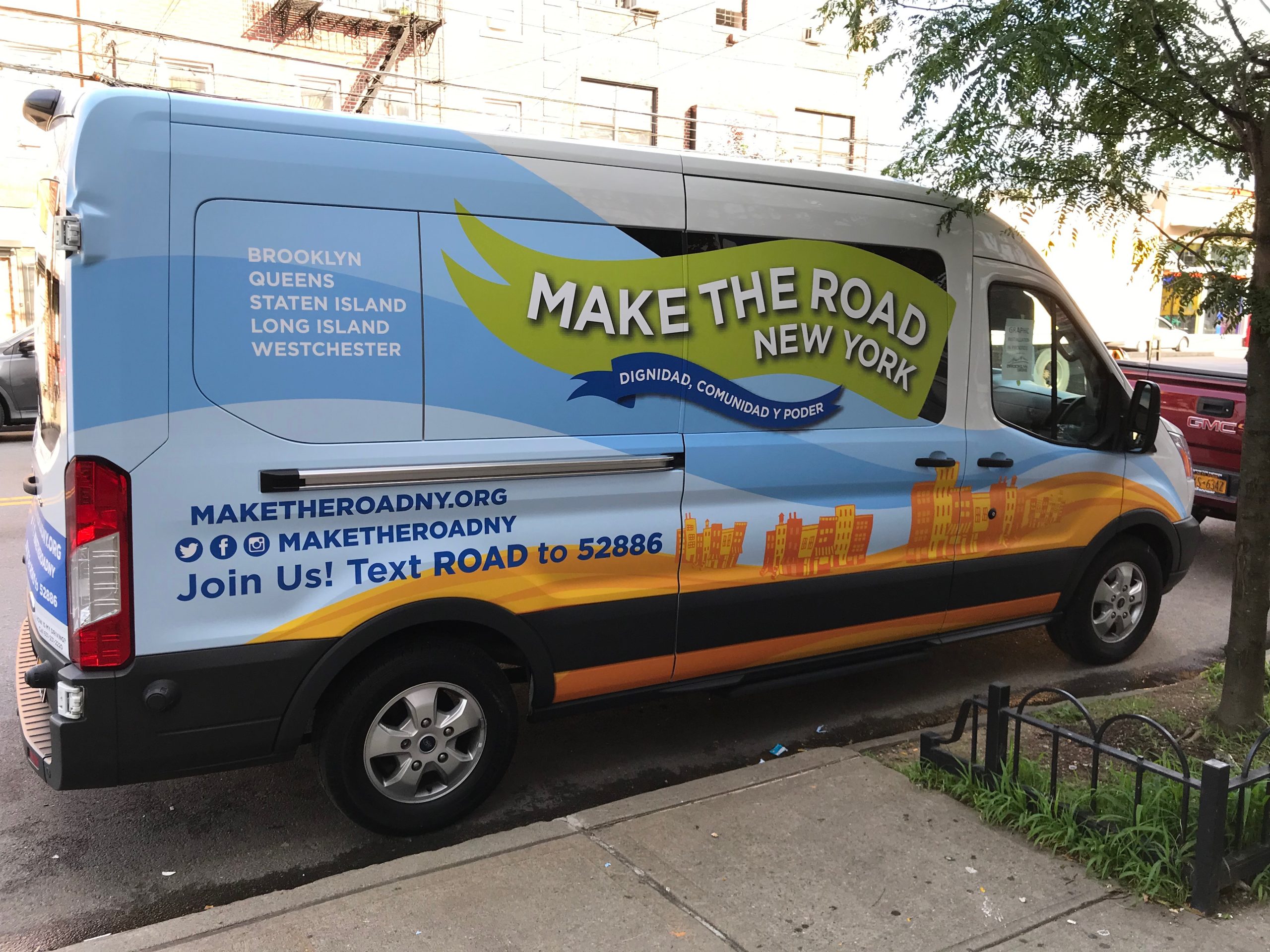
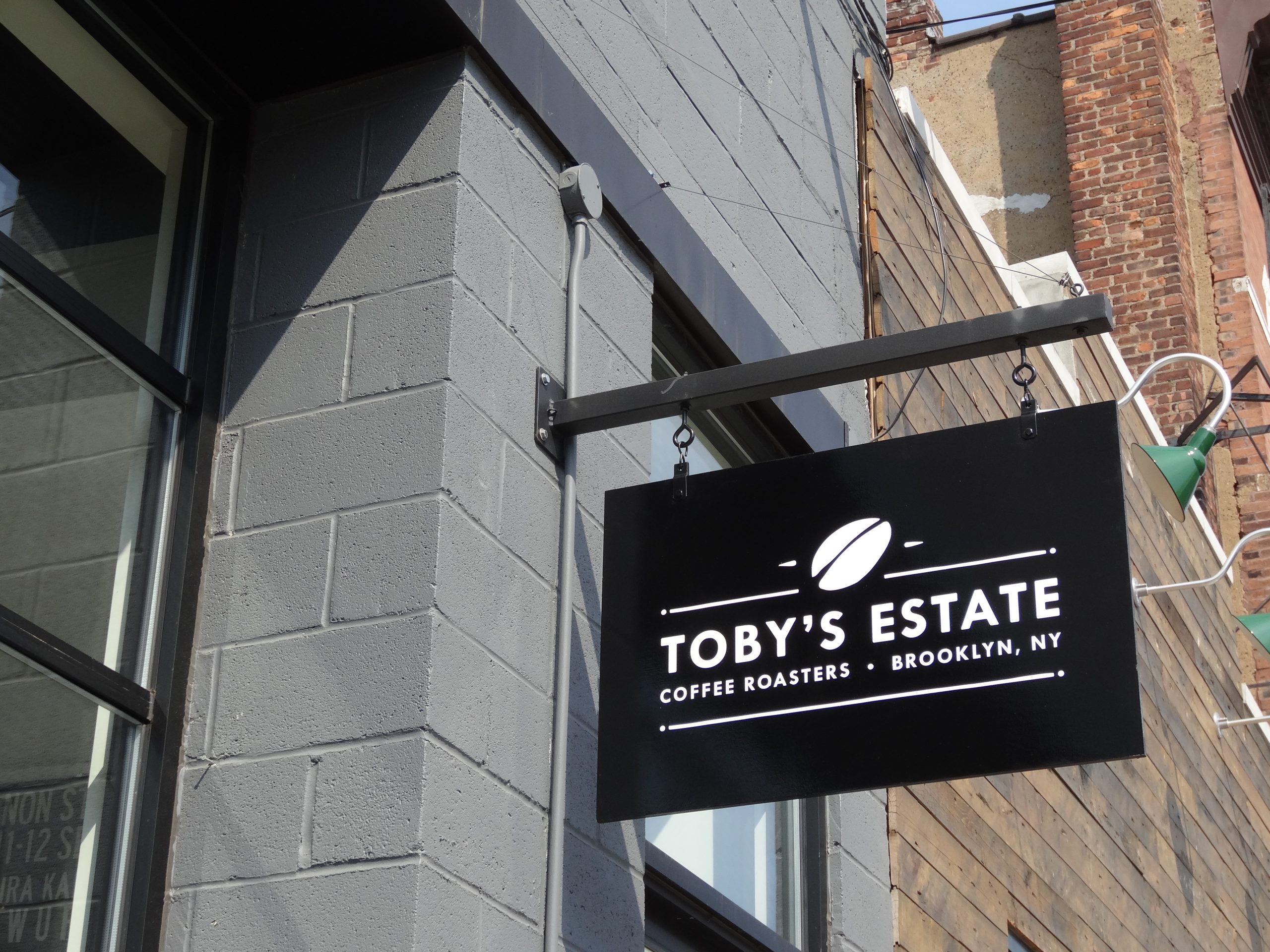
Both keep the rain off the door. Only one of them is held up entirely by the building.
The difference between an awning and a canopy comes down to support. An awning is attached to the building and held up by it alone, projecting from the wall over a window or door. A canopy has its own supports, posts or columns that carry at least part of its weight, and it can stand away from the building entirely.
In everyday speech the words get swapped, and many suppliers use them loosely. The distinction still matters, because the two are built differently, cost differently and are treated differently by building and zoning rules. This guide explains each one and how to choose between them for a business entrance.
Awning vs Canopy at a Glance
| Feature | Awning | Canopy |
|---|---|---|
| Support | Attached to and carried by the wall | Carried by posts or columns, at least in part |
| Typical size | Over a window, door or storefront | Over a walkway, entrance or outdoor area |
| Projection | Usually a few feet from the wall | Can extend well beyond the wall or stand alone |
| Covering | Fabric or metal over a frame | Fabric, metal, glass or polycarbonate |
| Common uses | Storefronts, windows, single entrances | Hotel entries, walkways, outdoor dining, drive thrus |
| Branding | Valance and face lettering | Fascia lettering and mounted signs |
What an Awning Is
An awning is a frame covered in fabric or metal, fixed to the building wall and projecting outward. Because the wall carries all of its weight, an awning stays relatively shallow, usually covering a window or a doorway and the strip of sidewalk in front of it.
Storefront awnings do three jobs at once. They shade the window display, give customers cover at the door, and carry the business name on the face or valance. See our commercial awnings page for frame shapes and fabric options.
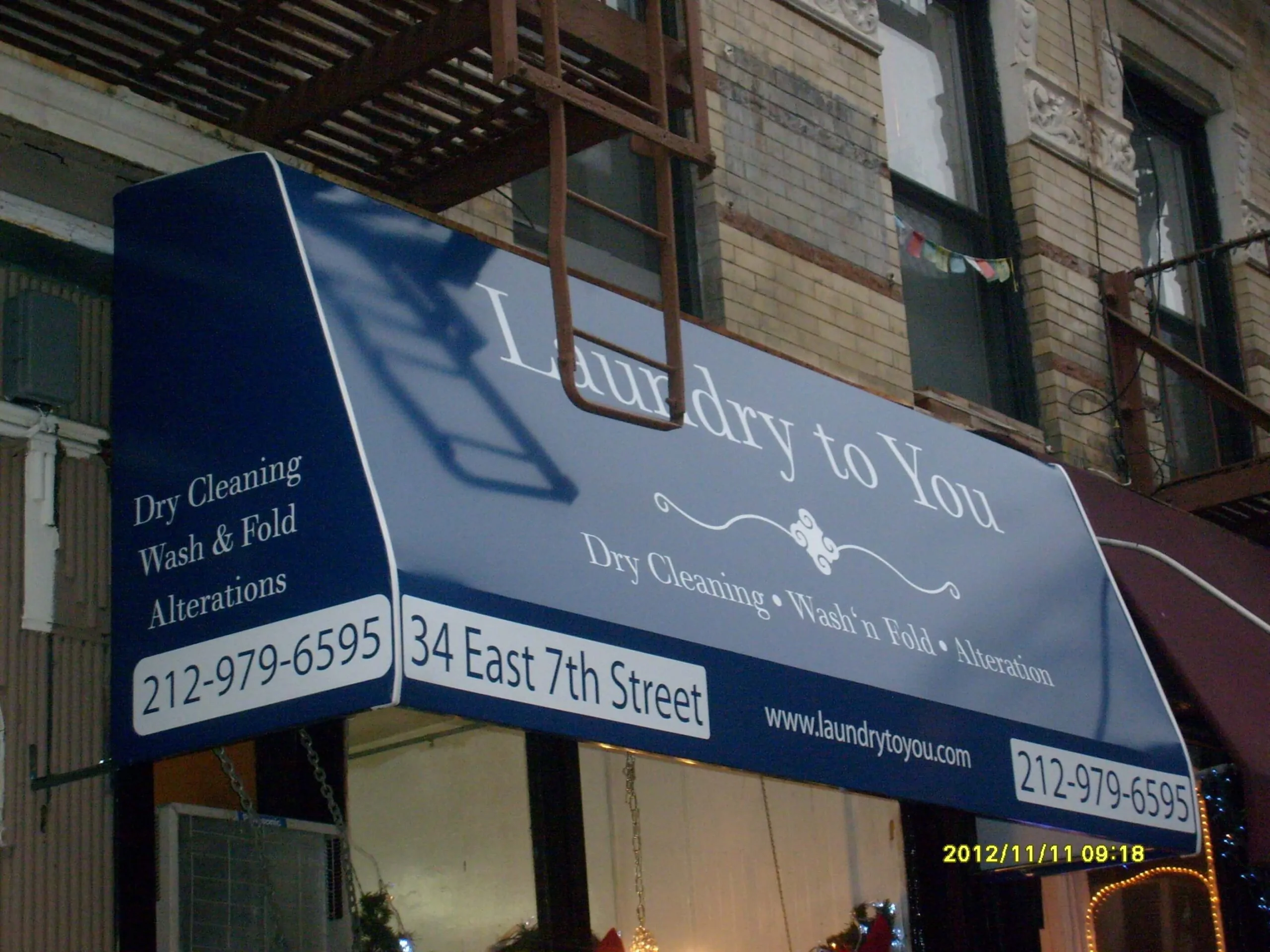
Awning Styles
- Traditional sloped: a straight slope with a valance at the front, the most common storefront style.
- Dome or quarter round: a curved profile that suits arched windows and entrances.
- Box or waterfall: a squared or curved front that gives a large flat face for lettering.
- Retractable: fabric that rolls back to the wall, common for outdoor seating.
What a Canopy Is
A canopy covers a larger area and is supported by posts, columns or a structure of its own. It may connect to the building on one side or stand completely free. Because it does not rely on the wall alone, a canopy can reach across a walkway, cover outdoor seating or shelter a drop off area.
Canopies tend to be heavier, more permanent structures, often in metal, glass or polycarbonate as well as fabric, and they usually need structural design and more involved approvals than a storefront awning. Canopy fascias often carry dimensional letters or a slim light box sign rather than printed fabric.
Which One Suits Your Entrance
Choose an awning when the goal is to shade a window, cover the door, and brand the storefront within a modest projection. It is the usual choice for shops, restaurants, salons and offices on a street, often paired with custom window decals on the glass below.
Choose a canopy when the covered area needs to be larger or deeper than a wall can carry, such as an entrance walkway, a hotel or hospital drop off, or a restaurant patio.
Fabric and Frame Choices
Most storefront awnings use solution dyed acrylic fabric, which holds its color in sun, or vinyl coated polyester, which is tougher and easier to clean and suits backlit awnings. The frame is usually welded aluminum or galvanized steel.
Ask the fabricator for the fabric’s flame resistance test report. Many jurisdictions require awning fabric to meet a flame test, and property owners and insurers often ask for it. Our guide to outdoor sign materials for New Jersey and NYC weather covers how fabrics and metals hold up.
Lettering Rules on Awnings
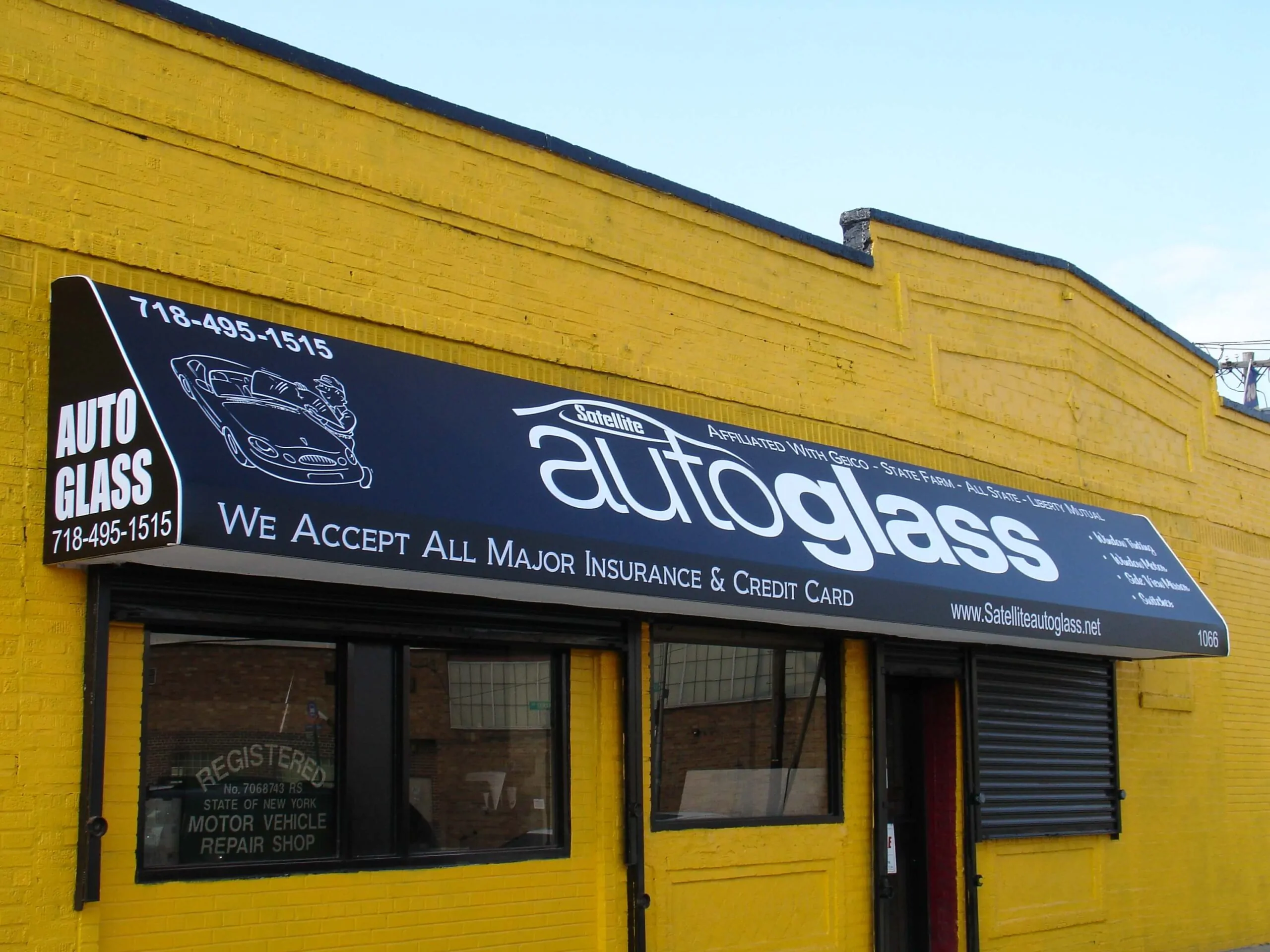
Towns often limit what can be printed on an awning, and the rules vary a lot:
- Marlboro: prohibits signs on awnings.
- Old Bridge: one sign of up to 8 square feet on an awning, in the valance only.
In New York City, buildings that are landmarks or sit in historic districts need a permit from the Landmarks Preservation Commission to install or replace an awning. Awnings are a familiar sight on busy neighborhood retail streets in Brooklyn, Queens and Union City, where a narrow storefront relies on the awning to carry its name. Our Brooklyn sign company and Union City sign services pages cover those neighborhoods.
Care and Lifespan
A quality fabric awning typically lasts many years before the fabric needs replacing, and the frame usually outlives several covers. Rinse the fabric with water a few times a year, clear leaves and debris from the top, and have tears repaired early before wind makes them worse.
Recovering an existing frame with new fabric costs less than a new awning and is the usual way to refresh a storefront or change the branding.
Common Questions About Awnings and Canopies
Is an awning the same as a canopy?
No. An awning is attached to and fully supported by the building wall, while a canopy has its own posts or supports and can cover a larger area or stand free.
Which is better for a storefront?
Usually an awning. It shades the window, covers the entrance and carries the business name without needing posts on the sidewalk.
Do awnings need a permit?
Often, yes. Awnings that project over a sidewalk or carry lettering usually need approval, and landmark buildings in New York City need a Landmarks Preservation Commission permit to install or replace one.
Can an awning have lettering?
Usually, within local limits. Many towns restrict lettering to the valance or to a set size, and some, such as Marlboro, prohibit signs on awnings entirely.
Can an awning be lit?
Yes. Backlit awnings use translucent vinyl fabric with lights inside the frame, so the whole face glows at night. Gooseneck lights mounted above are another option.
How long does an awning last?
The fabric usually lasts many years and the frame longer still, so most refreshes replace only the cover. Sun exposure and maintenance make the biggest difference.
Awnings Built for Your Storefront
Gogi Signs designs, fabricates and installs commercial awnings across New Jersey and New York City, and we check the local rules on lettering and projection before the frame is built.
See our storefront awnings page for styles and fabrics, browse our gallery of installed signs, then request a free quote with a photo of the entrance.