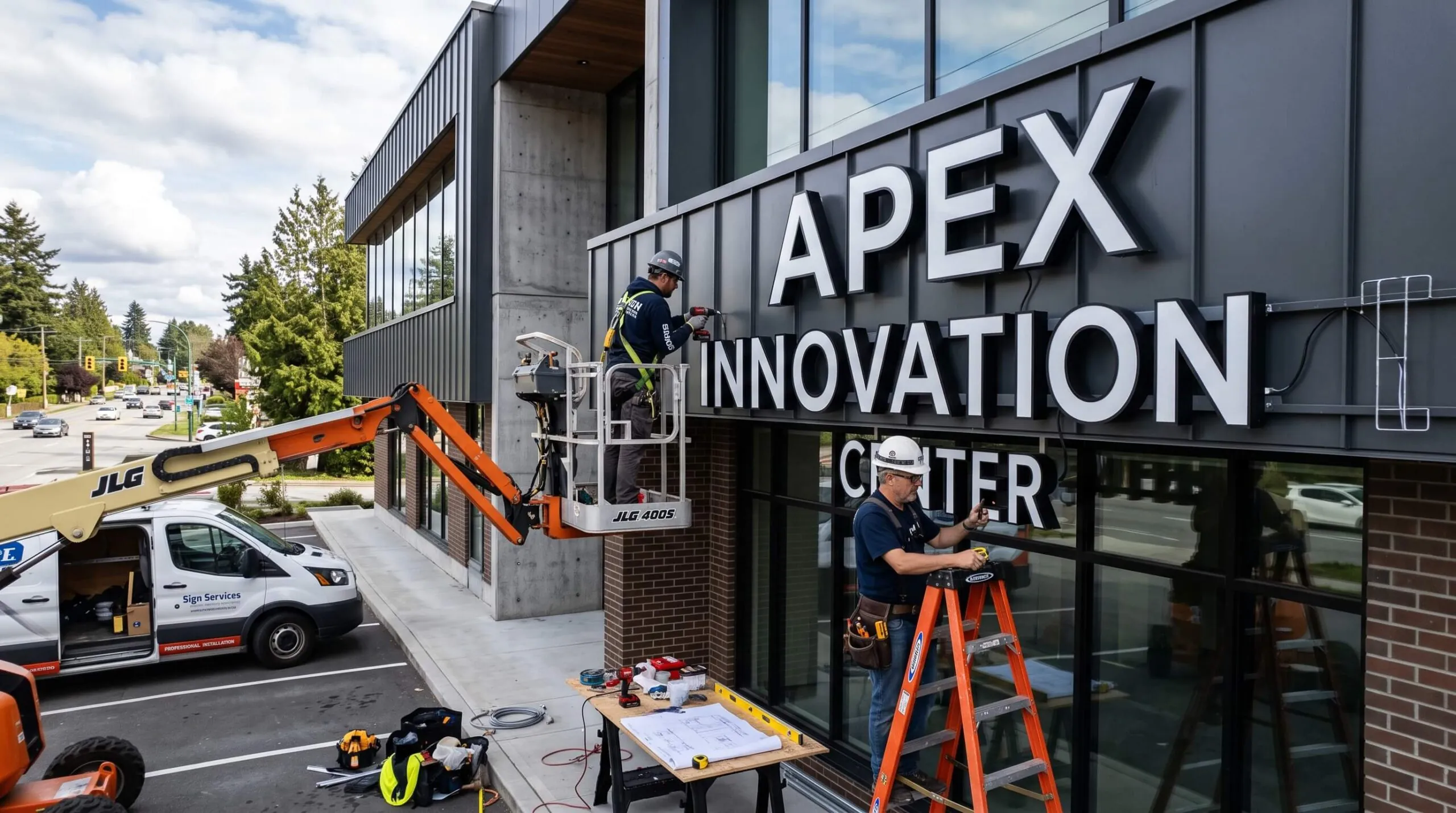
The short answer
To choose a custom sign company in New Jersey, pick one that has built your type of sign before, fabricates it in its own shop or tells you who does, files your town’s zoning permit and the state construction permit, uses a licensed electrical contractor and UL-listed parts for lit signs, carries liability and workers’ compensation insurance, and gives you an itemized quote after measuring your site. Get three to five quotes, compare them line by line, and put the timeline, permits, warranty and file ownership in writing before you pay a deposit.
That is the short answer. The rest of this guide explains how a sign project in New Jersey actually works, the types of sign companies you can hire and the trade-offs of each, a step-by-step selection process, and the details most first-time buyers only learn after something goes wrong.
Quick checklist
- ✓relevant portfolio
- ✓in-house fabrication (or a named fabricator)
- ✓permit filing included
- ✓licensed electrician for lit signs
- ✓UL-listed sign
- ✓certificate of insurance
- ✓site survey before final price
- ✓itemized quote
- ✓written warranty
How a custom sign project works in New Jersey
A custom sign company does more than print or build a sign. For a permanent business sign in New Jersey, the job usually covers six stages, and the company you hire should be able to explain who handles each one.
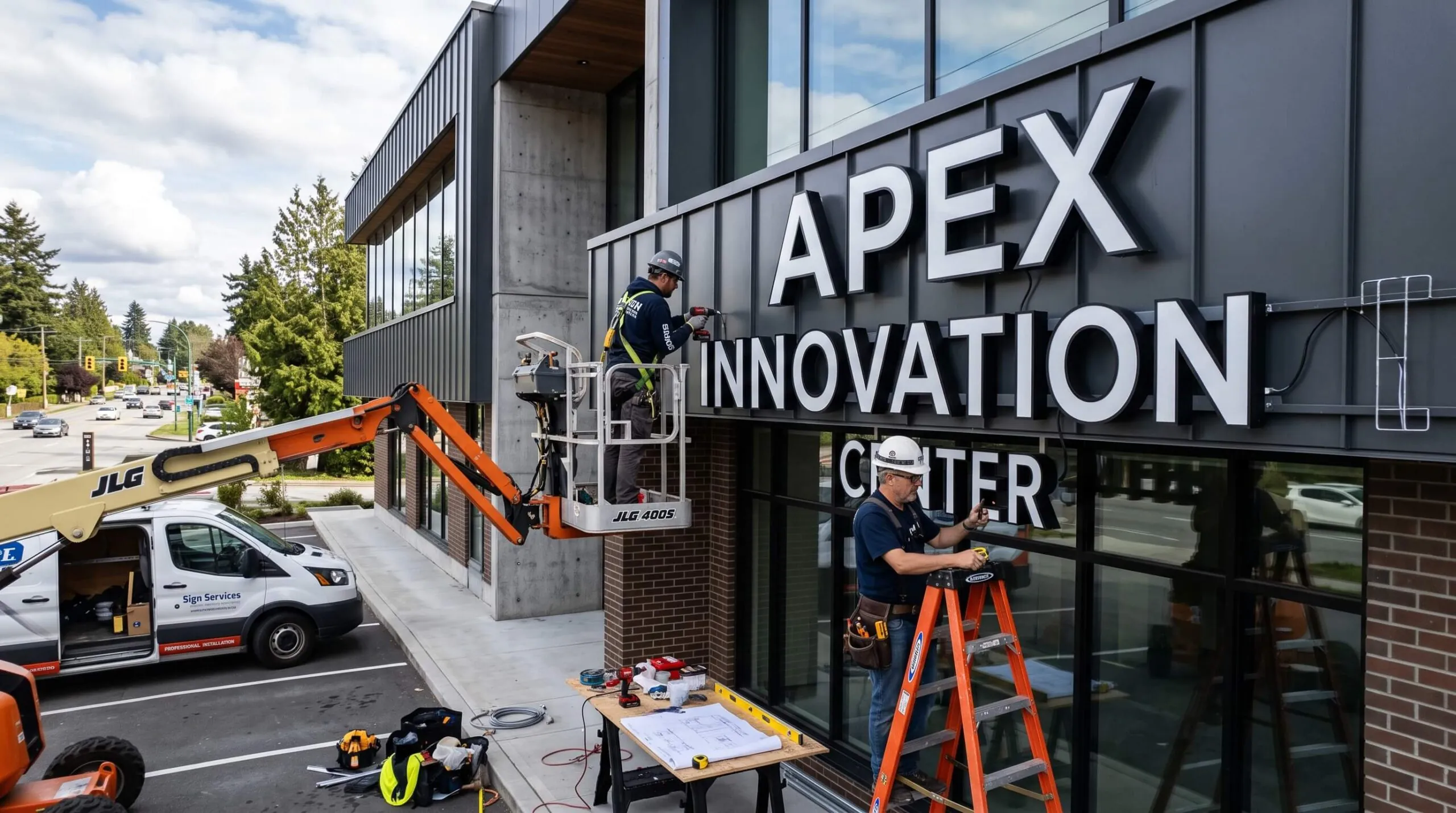
| Stage | What happens | Who should handle it |
|---|---|---|
| Site survey | Measure the wall, check mounting surface, power and access | Sign company |
| Design and drawings | Artwork, dimensions, materials, mounting and lighting details | Sign company |
| Approvals | Landlord sign criteria, zoning sign permit, NJ construction permit | Sign company files; you sign off |
| Fabrication | Cutting, printing, assembly, wiring | Sign company or its named fabricator |
| Installation | Mounting, electrical connection, inspection | Sign company crew plus licensed electrician |
| Service | Repairs, LED replacement, face changes | Sign company |
Knowing these stages tells you what to compare. Two companies can quote the same sign and include very different parts of this list.
Typical timeline
Design, approvals and fabrication run in sequence, so the approval stage often sets the pace. Under the state construction code, the construction official must approve or deny a complete permit application within 20 business days (N.J.A.C. 5:23-2.16). Zoning review runs separately and varies by town. A sign that needs a variance adds a public hearing, which can stretch the schedule by months. If you are opening a new location, build these steps into your opening-day signage plan from the start.
Types of sign companies in New Jersey: pros and cons
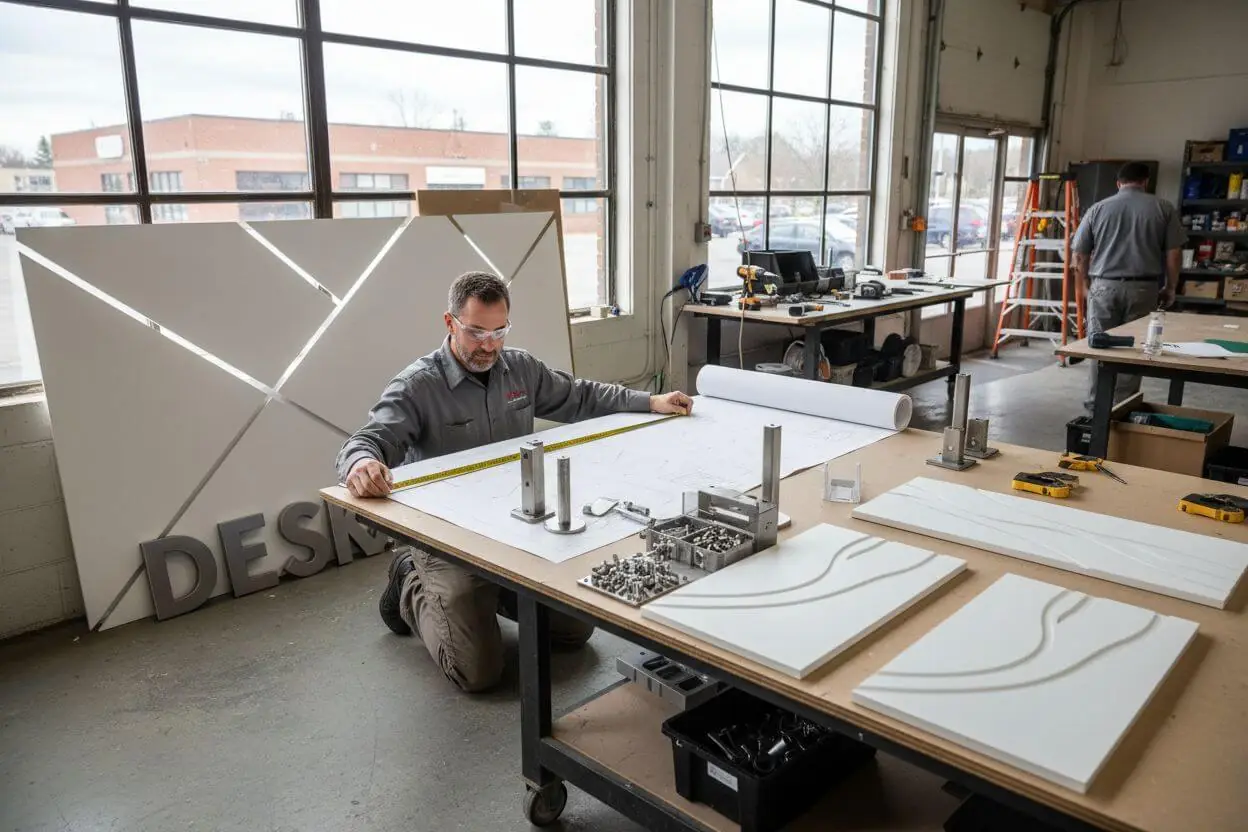
Not every business that sells signs builds them. Matching the type of company to your project matters more than any single company’s sales pitch.
| Type | Best for | Pros | Cons |
|---|---|---|---|
| Local design-build sign shop | Storefront, lit, dimensional and multi-sign projects | One team from survey to install; knows local permit offices; fast service calls | Capacity limits on very large national rollouts |
| Franchise sign and print shop | Graphics, banners, interior and rigid signs | Many locations; standardized process | Fabrication and install capacity varies by location; complex lit signs may be outsourced |
| National sign company | Brands rolling out dozens of locations across states | Program management, consistency across markets | Less local permit knowledge; higher overhead on a single sign |
| Broker, agency or reseller | Businesses that want one contact for branding and signs | Single point of contact for design and brand | Doesn’t build the sign; fixes and timelines depend on a third party |
| Online sign printer | Yard signs, banners, simple panels | Low price, fast shipping | No site survey, permits, installation or electrical work |
Which type fits your project
For a single storefront or office in New Jersey, a local design-build shop is usually the most efficient choice, because the same team that measures your wall also files the permit and installs the sign. For a brand opening many locations in several states, a national program company can make sense, as Federal Heath notes in its own hiring guide (Federal Heath). For temporary signs, an online printer is often enough; our guide to temporary or permanent signage covers that split.
Step-by-step: how to choose a sign company in NJ
Follow these steps in order. Each one filters out companies that would cause problems later, before you spend time comparing prices.
1
Step 1: Define the sign before you call anyone
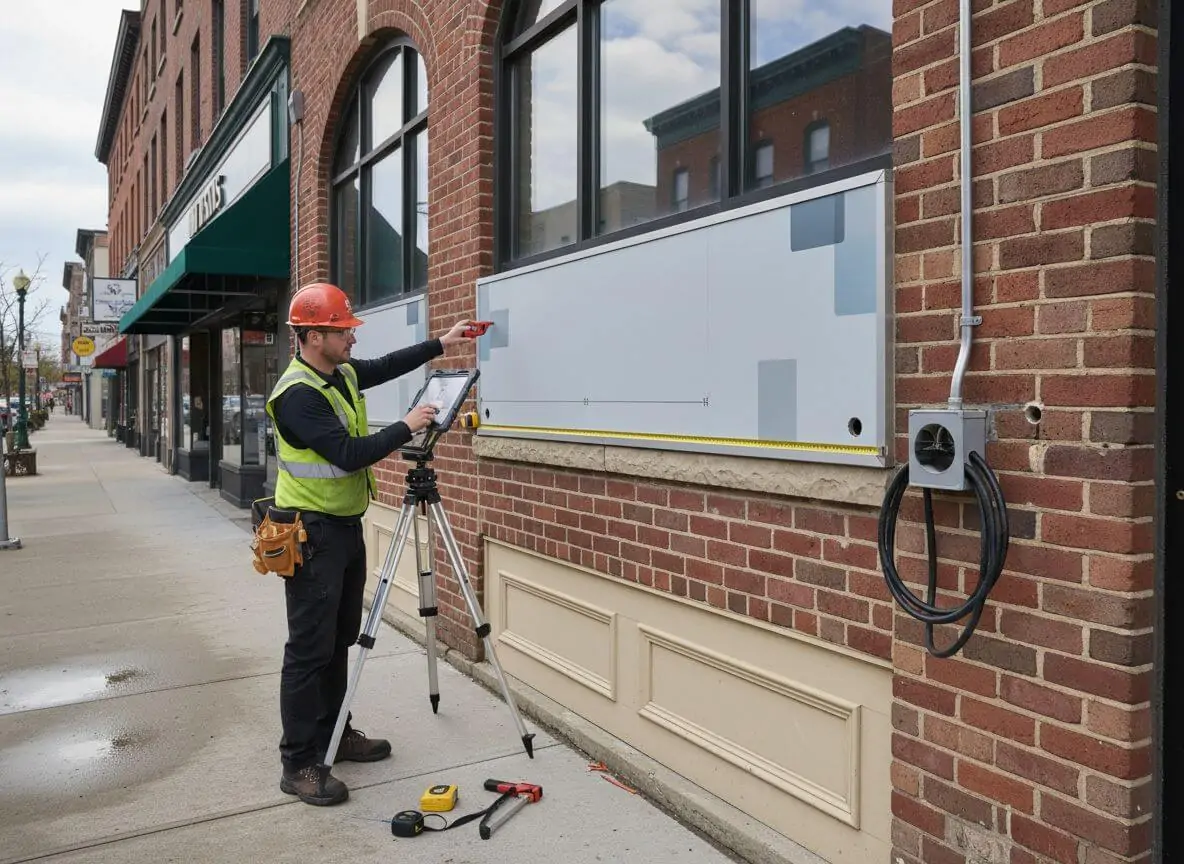
Write down the sign type, location on the building, approximate size, whether it is lit, your deadline and a budget range. A company can only quote accurately against a clear brief.
Know your sign type
The main categories behave very differently in cost, permits and installation:
- Lit wall signs: illuminated storefront letters and lit cabinet signs need electrical work and a construction permit.
- Projecting signs: signs that hang over the sidewalk raise clearance and structural questions.
- Panels and graphics: printed rigid panels and window graphics are simpler and faster.
- Interior signs: lobby and reception signage and ADA room signs have their own accessibility rules.
Set a realistic budget
Federal Heath puts average costs for illuminated exterior signs at $3,000 to $10,000, with digital installations that can exceed $25,000 (Federal Heath). New Jersey prices vary with size, materials, lighting, mounting height and permits, so treat any range as a starting point rather than a quote.
2
Step 2: Check your lease and your town’s rules first

Before any design work, find out what you are allowed to install. This step prevents the most expensive mistake in signage: building a sign that can’t be approved.
Landlord sign criteria
Most commercial leases include sign criteria covering size, color, lighting and mounting. Your landlord’s approval is required, but it does not replace town approval, a point covered in our list of mistakes that slow down sign projects.
Municipal zoning rules
Each New Jersey municipality sets its own sign rules for size, number, placement and lighting. Newark, for example, requires a sign permit from the Zoning Officer and, where the state code requires it, a building permit from the Construction Official before a sign is erected or modified (Newark Code §41:9-5). Rules in Linden, Jersey City or Paterson differ.
When your sign needs a variance
If your sign exceeds what your zoning code allows, you need variance relief from the local zoning or planning board. That means a formal application, a public hearing and written notice to owners of property within 200 feet (Municipal Land Use Law notice, example from North Brunswick). A good sign company will tell you early whether your design fits the code and suggest a compliant version before you commit to a hearing.
3
Step 3: Shortlist three to five companies with relevant work
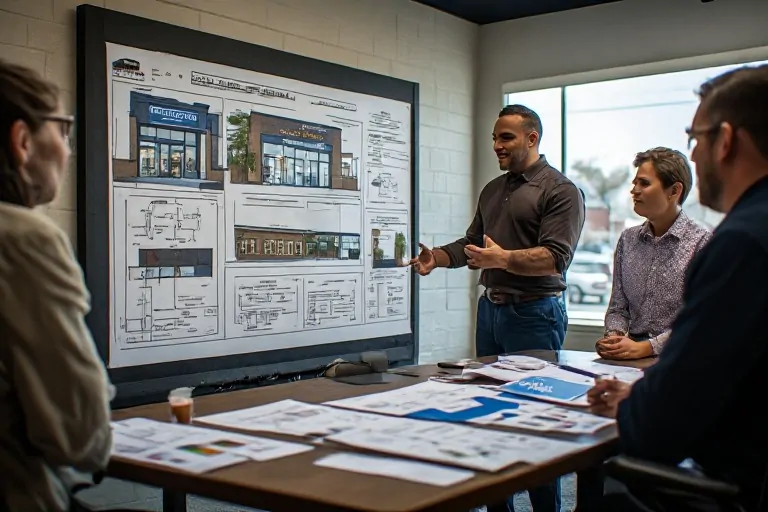
Federal Heath recommends a shortlist of three to five companies. Build it from companies that have installed signs like yours, not just any signs.
Review installed work, not renderings
Ask for photos of finished, installed signs of your type. A shop that excels at printed panels and banners may have little experience with lit cabinets or dimensional letters.
Read reviews for patterns
Look for repeated comments about deadlines, communication and service after installation. One bad review is noise. Five reviews that mention missed deadlines are a pattern.
Call a reference
The International Sign Association suggests asking for names and contacts of past customers (ISA). Ask the reference whether the job finished on time and whether permits caused delays.
4
Step 4: Find out who actually builds the sign
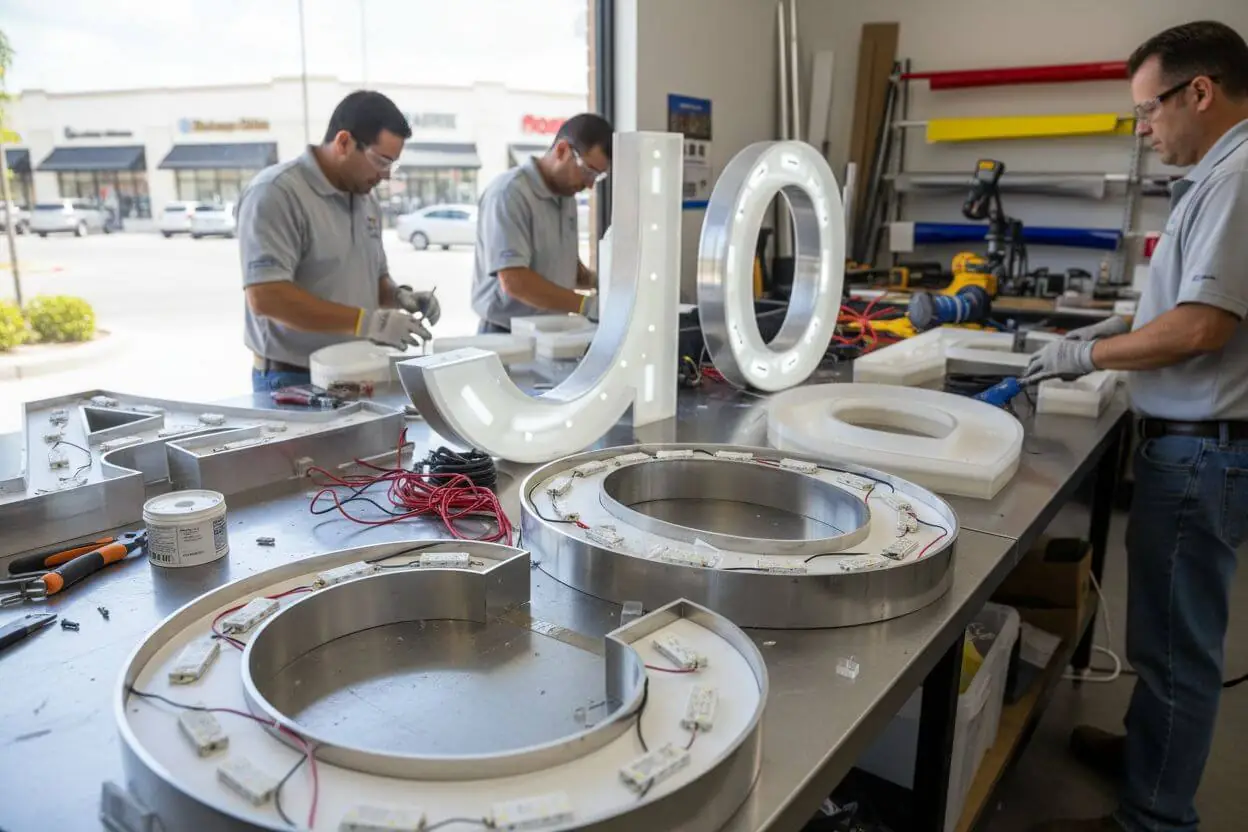
Ask every company which parts of the sign it makes itself. Many companies that sell signs send fabrication to a wholesale shop, which is a legal and common model. Gogi Signs, for example, runs a trade program for other sign companies with blind shipping, so the company you hire may not be the shop that builds your sign.
Pros and cons of in-house fabrication
| In-house fabricator | Reseller or broker | |
|---|---|---|
| Accountability | One company owns every defect | Fixes depend on the outside fabricator |
| Schedule | Controls its own production queue | Depends on the wholesaler’s backlog |
| Price | Fewer markups | Extra margin layer |
| Flexibility | Limited to its own equipment | Can source unusual sign types |
How to verify
The ISA suggests asking whether you can visit the plant. A real fabrication shop will show you routers, printers and assembly benches. Also ask which equipment they own: CNC routing, laser cutting, large-format printing and wiring cover most custom sign fabrication.
5
Step 5: Verify licenses, listings and insurance

This is the step most buyers skip and the one that causes failed inspections and liability disputes.
Electrical contractor license for lit signs
New Jersey’s Board of Examiners of Electrical Contractors requires electrical contractors to be licensed and hold a valid business permit, and says a license is required for electrical work outside listed exemptions such as work under 10 volts (NJ Board FAQ). Ask who makes the electrical connection and for that contractor’s license number.
How to check a license
Use the Licensee Search on the NJ Division of Consumer Affairs website under the Board of Examiners of Electrical Contractors, or call the Board at (973) 504-6410.
UL listing for electric signs
The National Electrical Code requires electric signs to be listed and installed according to that listing (NEC 600.3), and UL 48 is the US construction standard for electric signs (IAEI Magazine).
What happens if the sign has no label
An inspector who finds an electric sign without a listing label can require written special permission, order a field evaluation by a certification company, or reject the installation. Ask whether your finished sign will carry a UL or other Nationally Recognized Testing Laboratory label.
Insurance
Ask for a certificate of insurance (COI) before installation; commercial landlords often require one naming them. New Jersey law requires employers to carry workers’ compensation, and not carrying it is a disorderly persons offense that can bring stop-work orders and fines of up to $5,000 per 10-day period (WorkersCompensation.com). The ISA’s own checklist asks: “Are you fully insured, including worker’s compensation? Will you provide a current copy?”
Installer certifications
For window graphics, wall wraps and fleet and van wraps, 3M certification is a useful signal. Certified installers pass hands-on and written tests at 3M’s facility in Saint Paul, Minnesota, and work for companies that have been in business at least three years and carry liability insurance (3M).
6
Step 6: Get a site survey and an itemized quote
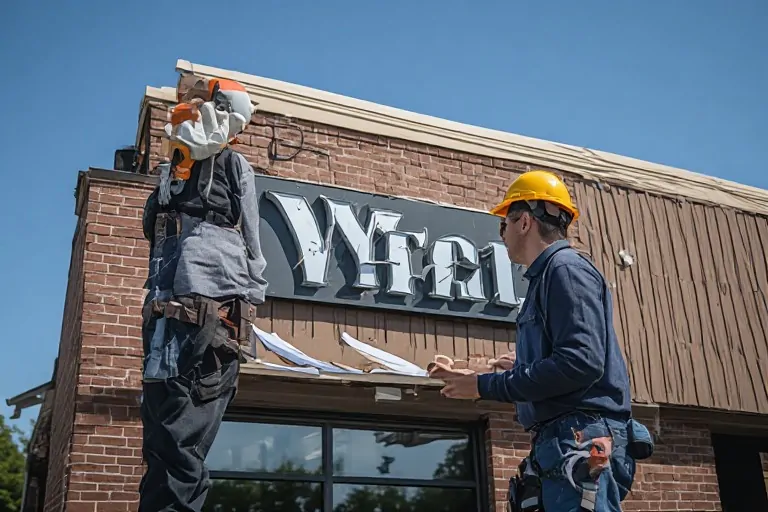
A storefront sign priced from a photo often changes once someone measures the wall, checks the mounting surface and finds the power source. Ask for a site visit before the final price; some companies, including Gogi Signs, offer a free on-site survey.
What an itemized quote should list
| Line item | What it should say |
|---|---|
| Size and type | Exact dimensions, letter height, depth, number of faces |
| Materials | Face, returns, backer, substrate and thickness |
| Lighting | Light source and UL listing |
| Mounting | How it attaches to your wall or structure |
| Permits | Which permits are included and who files |
| Electrical | Who connects power; licensed contractor included or not |
| Installation | Crew, lift or equipment, access needs |
| Removal | Whether taking down the existing sign is included |
| Warranty | Coverage, length, parts and labor |
| Timeline | Design, permit, production and install estimates |
For material lines, our guide to outdoor sign materials that hold up in NJ weather explains what each substrate is good for.
7
Step 7: Compare quotes line by line
Put the quotes side by side using the table above. The lowest total often excludes permits, electrical work or removal, and those costs come back later as change orders. Compare what is included before comparing price.
8
Step 8: Read the contract before paying a deposit
Many custom sign shops ask for a deposit before production, because a sign built for your business can’t be resold. Before paying, confirm the contract covers:
- Scope: the itemized quote attached, with approved drawings
- Permits: who files and who pays the fees
- Timeline: milestones for drawings, permit submission, production and install
- Change orders: how changes are priced
- Warranty: written terms for parts and labor
- Design files: who owns the artwork and which file formats you receive
Who owns the design files
Many sign shops keep ownership of the production files they create and give customers proofs rather than editable vector files. Sign makers on industry forums advise putting file ownership in the contract (Signs101). If you want editable files for future use, ask for them in writing up front.
9
Step 9: Approve drawings, then inspect the installation
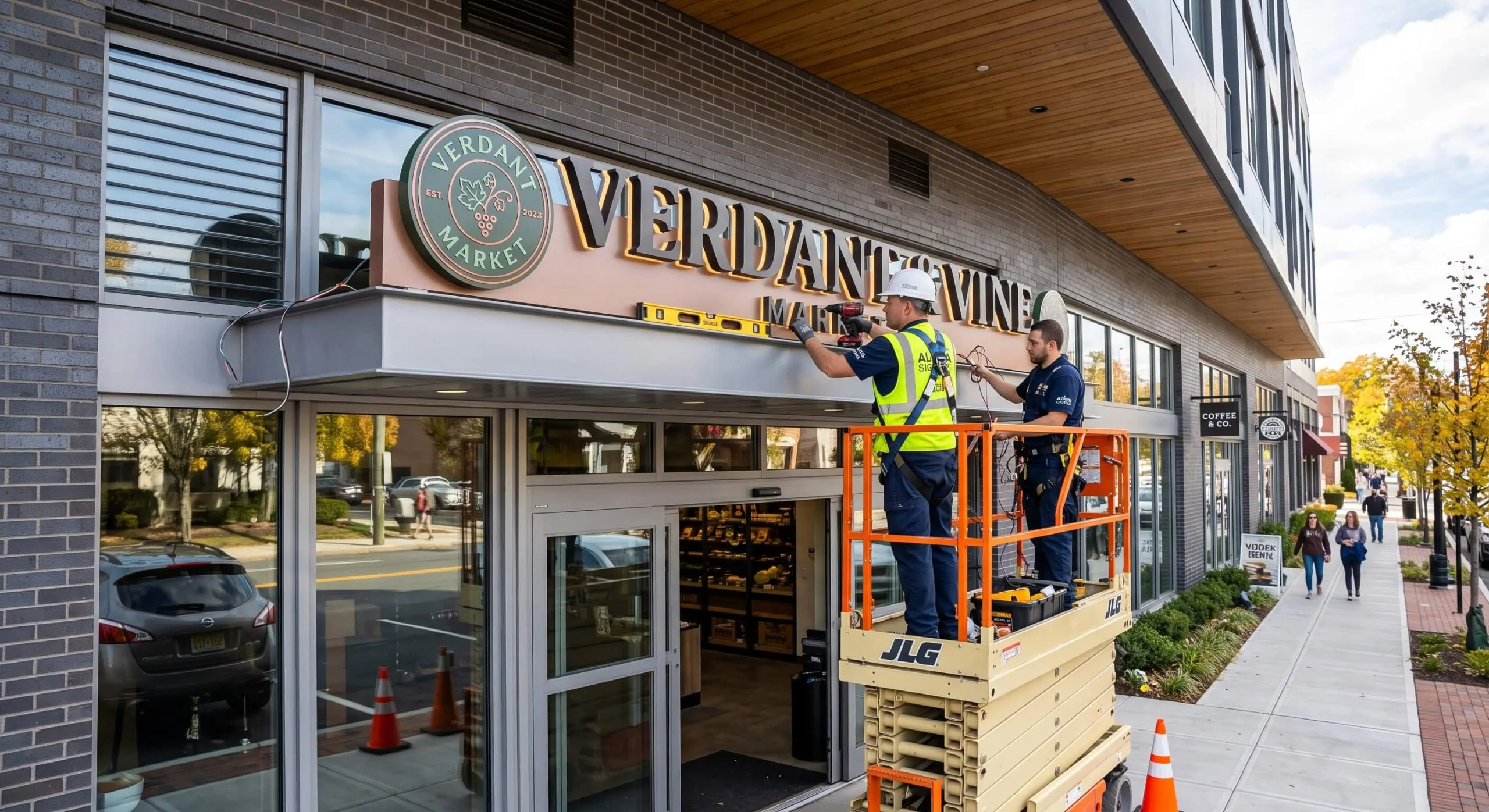
Approve final drawings before fabrication starts. After installation, walk the sign with the installer: check level, fastening, lighting, and that electrical work has passed inspection. Federal Heath recommends a final walkthrough and sign-off documentation.
10
Step 10: Plan for service and future changes
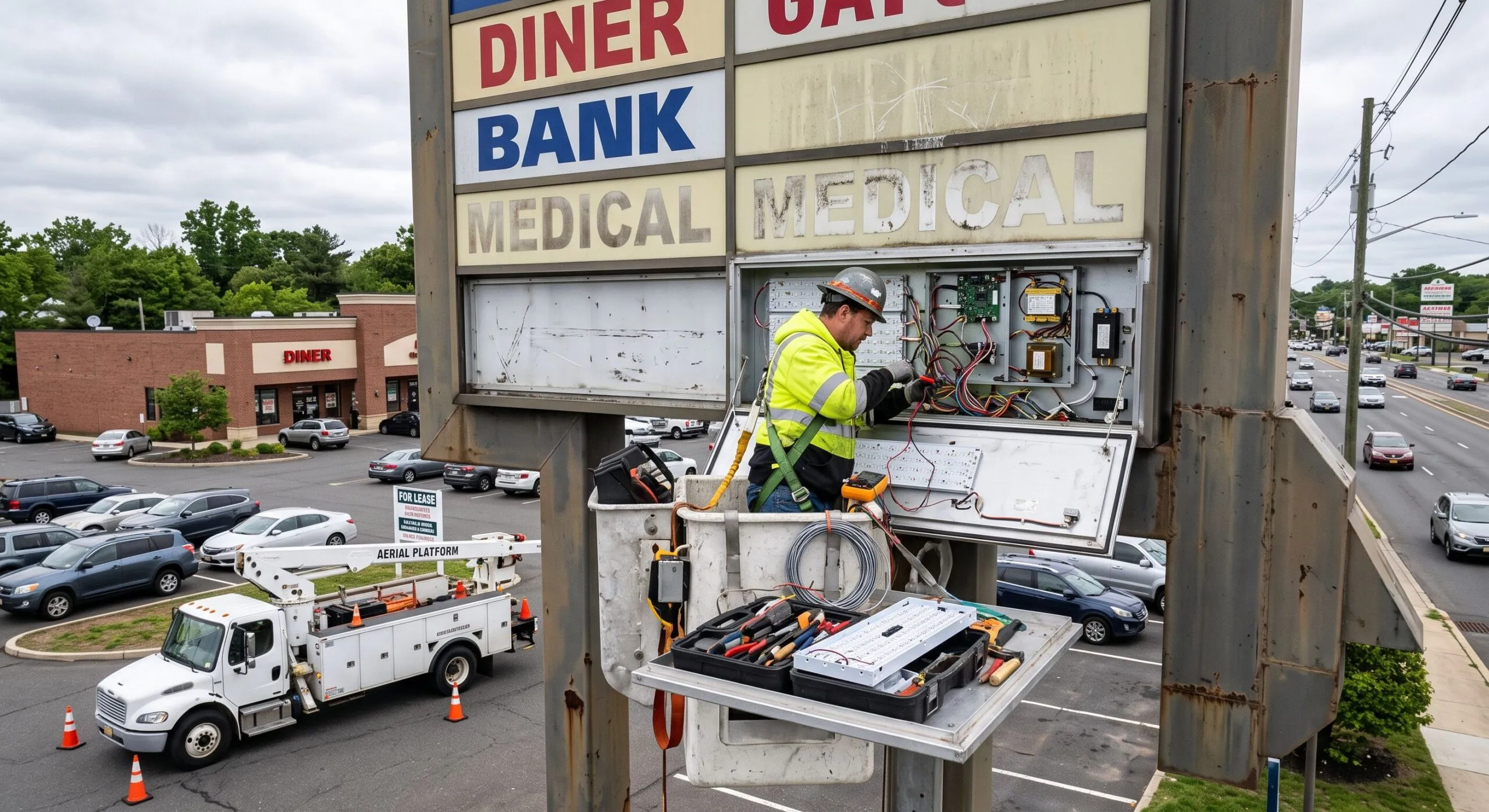
Ask how much maintenance your sign needs and whether the company offers maintenance plans, as the ISA suggests. Find out who you call when a letter goes dark and how fast they respond. A local shop with in-house repair and maintenance services can reach a New Jersey site faster than one that subcontracts service. Keeping drawings on file also makes a future rebrand on existing sign structures cheaper.
What most business owners don’t know about hiring a sign company
These are the points first-time buyers usually learn too late.
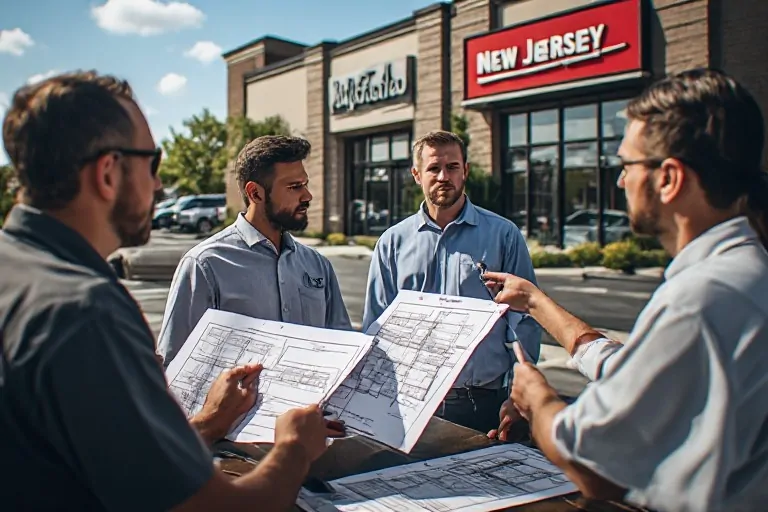
The company you hire may not build your sign
Resellers and agencies often buy signs from wholesale fabricators with blind shipping. That is not a problem in itself, but you should know who the fabricator is and who fixes defects.
Landlord approval is not a permit
A signed lease exhibit does not authorize installation. Zoning and construction approvals come from the town.
Almost every wall or lit sign needs a construction permit
Under N.J.A.C. 5:23-2.14, a sign is exempt from a construction permit only if it is ground-supported, has no electrical circuit, is no larger than 25 square feet on one side and is mounted no more than six feet high (N.J.A.C. 5:23-2.14). Wall signs and lit signs fail at least one of those tests.
An unlisted electric sign can fail inspection
Without a UL or equivalent listing label, an inspector can reject the installation. Retrofitting or field-evaluating a sign costs time and money.
A variance is a public process
Oversized signs need board approval, a hearing and notice to neighbors within 200 feet. Designing to the code is usually faster than asking for an exception.
NYC has its own rules
If you also have locations in the five boroughs, the NYC Department of Buildings requires a licensed sign hanger for most signs over 75 square feet or 25 pounds (NYC DOB). Ask whether your New Jersey sign company works in the NYC boroughs and who performs those installs.
Red flags when choosing a sign company
Any one of these is a reason to ask more questions. Two or more is a reason to walk away.
- 1No physical shop, and no answer about who fabricates the sign
- 2A final price given without a site visit on a wall-mounted or lit sign
- 3“Permits by customer” on a sign that clearly needs a construction permit
- 4No electrical contractor named for a lit sign
- 5No certificate of insurance before installation
- 6Quotes that say “channel letters, installed” with no sizes or materials
- 7A large deposit with no written timeline
- 8No written warranty
Questions to ask a sign company, and what good answers sound like
| Question | Good answer | Warning sign |
|---|---|---|
| Who builds the sign? | “We fabricate it in our shop,” or a named fabricator | Vague or no answer |
| Who files the permits? | “We file zoning and construction permits” | “That’s on you” |
| Who connects the power? | A named licensed electrical contractor | “Our installer handles it” with no license |
| Will the sign be UL listed? | Yes, with the label applied | Unsure |
| Can I see your insurance? | COI sent before install | Delays or refusal |
| Do you visit the site first? | Yes, before final pricing | Price from a photo only |
| Who installs? | Own crew, or a named, insured subcontractor | Unknown |
| What is the warranty? | Written terms, parts and labor | Verbal only |
| Who services the sign later? | Their own service team | No service offered |
Our expert take: what matters most
After two decades of building signs in New Jersey, the pattern we see is consistent: most sign problems start before fabrication. A sign that was never surveyed, never checked against the town code or never planned with an electrician is the sign that gets delayed, redone or rejected. Price differences between qualified companies are usually smaller than the cost of one failed inspection or one rebuilt sign.
So weigh the steps in this order: relevant experience, permit and electrical competence, insurance, and only then price. And choose the type of company that fits the job. A national program company may be right for a 40-state rollout. An online printer is fine for a yard sign. For a single storefront, office or campus in New Jersey, a local shop that designs, builds, permits and installs under one roof removes the most risk.
Still unsure? Why NJ businesses choose Gogi Signs
If you have read this far and still aren’t sure which company to trust, Gogi Signs checks every box in this guide. We are a family-owned sign company that has designed, built and installed signs in New Jersey since 2005.
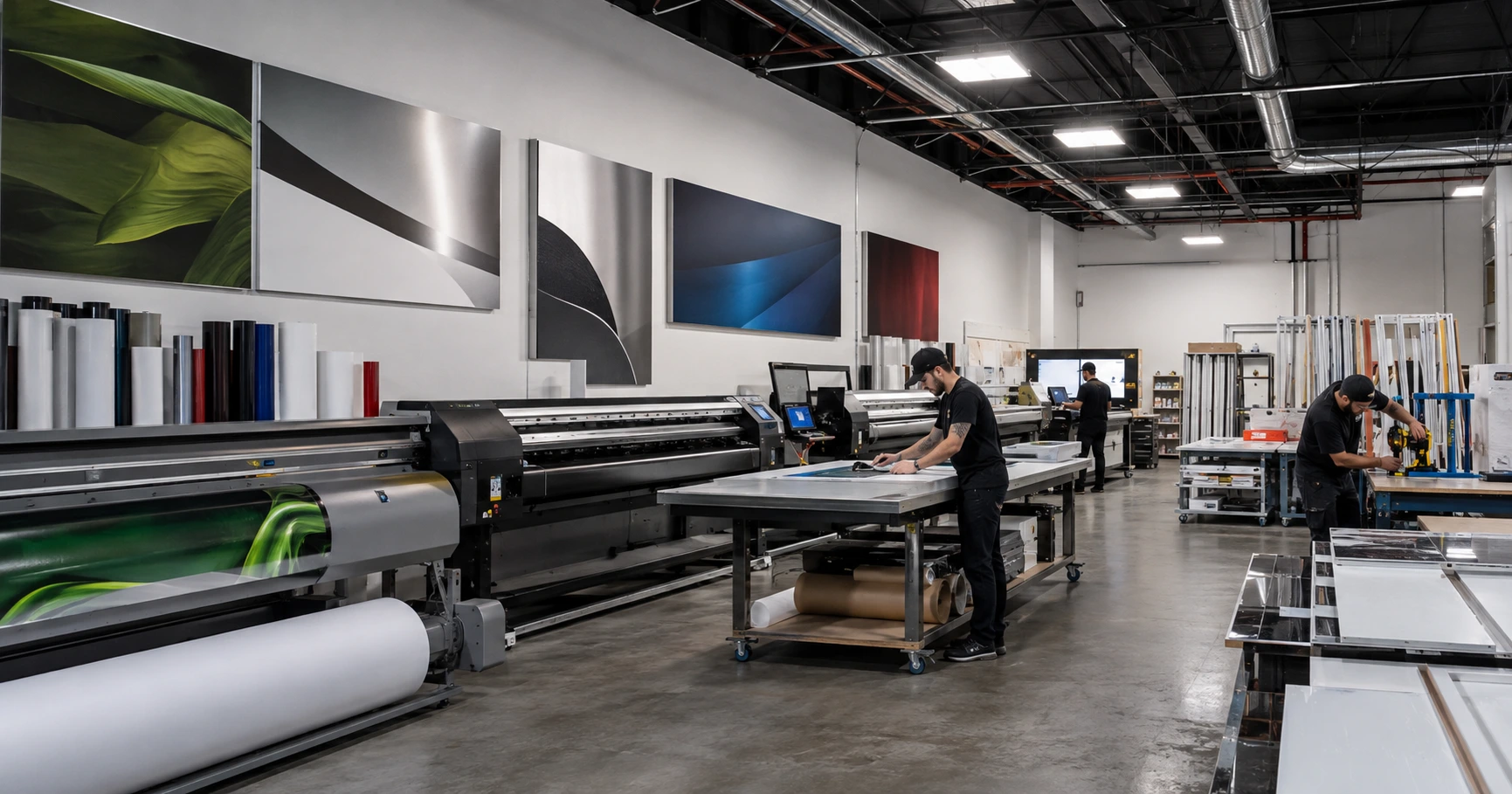
Built in-house: a 10,000-square-foot Linden shop with CNC routing, laser cutting, metal fabrication and large-format printing
Permits handled: we file zoning review and the NJ construction permit with your township
Insured crews: our own installation crews, with COI documentation for managed properties and commercial job sites
3M certified installers for vinyl, wraps and commercial graphics
Free site surveys before final pricing
Trusted by the trade: other sign companies and agencies use our wholesale program to build their signs
Coverage: all 21 New Jersey counties and the five NYC boroughs
See completed projects in our gallery, learn more about the Gogi team, or request a project estimate. You can also call 908-486-7000.
Frequently asked questions
What should I look for in a custom sign company in New Jersey?
Look for relevant installed work, in-house fabrication or a named fabricator, permit filing, a licensed electrical contractor and UL-listed parts for lit signs, a certificate of insurance including workers’ compensation, a site survey before final pricing, and a written warranty.
How many quotes should I get for a business sign?
Three to five. Fewer makes it hard to spot missing line items; more rarely changes the decision.
How much does a custom business sign cost in New Jersey?
It depends on size, materials, lighting, mounting and permits. Federal Heath cites $3,000 to $10,000 as an average range for illuminated exterior signs and over $25,000 for some digital installations. Simple printed panels cost far less.
How long does a custom sign take in New Jersey?
It depends on design approval, permits and fabrication. Once a complete construction permit application is filed, the construction official has 20 business days to approve or deny it. Zoning review varies by town, and a variance adds a public hearing.
Do I need a permit for a business sign in New Jersey?
Usually, yes. Most towns require a zoning sign permit, and the state construction code requires a construction permit unless the sign is ground-supported, unlit, no larger than 25 square feet and no higher than six feet.
Who is responsible for getting the sign permit?
The sign company should file it, because reviewers ask for drawings, dimensions, mounting details and electrical information that the sign company prepares. Confirm this in the contract.
What happens if my sign is bigger than my town allows?
You either redesign to fit the code or apply for a variance from the local zoning or planning board, which requires a public hearing and notice to property owners within 200 feet.
Does my landlord’s approval replace the town permit?
No. Landlord approval is a lease requirement. Zoning and construction permits come from the municipality.
Does an illuminated sign need a licensed electrician in New Jersey?
Yes. New Jersey requires a licensed electrical contractor for electrical work outside narrow exemptions such as work under 10 volts. Connecting a sign to building power is not exempt.
What does UL listed mean for a sign?
It means the sign was built to a recognized safety standard, UL 48 for electric signs, and evaluated by a Nationally Recognized Testing Laboratory. The National Electrical Code requires electric signs to be listed.
How do I verify a New Jersey electrical contractor’s license?
Use the Licensee Search on the NJ Division of Consumer Affairs website under the Board of Examiners of Electrical Contractors, or call the Board at (973) 504-6410.
What insurance should a sign company have?
General liability, shown on a certificate of insurance, and workers’ compensation, which New Jersey requires of employers. Many landlords also require being named on the certificate.
Should I choose a local or a national sign company?
For one or a few locations in New Jersey, a local design-build shop is usually faster and knows the permit offices. For dozens of locations across several states, a national program company can coordinate the rollout.
Is it safe to order business signs online?
For yard signs, banners and simple panels, yes. Online printers don’t survey your site, file permits, connect power or install, so they are a poor fit for permanent wall or lit signs.
Who owns the design files for my sign?
It depends on the contract. Many shops keep their production files and supply proofs. If you want editable vector files, ask for them in writing before work starts.
What warranty should a custom sign have?
Get written terms that state what is covered, for how long, and whether parts and labor are both included. Federal Heath notes LED modules typically last 50,000 hours or more with periodic maintenance.
Can a sign company install a sign I bought somewhere else?
Many can. Gogi Signs, for example, provides installation for businesses and other sign companies. Expect the installer to check the sign’s listing, mounting hardware and drawings before quoting.
