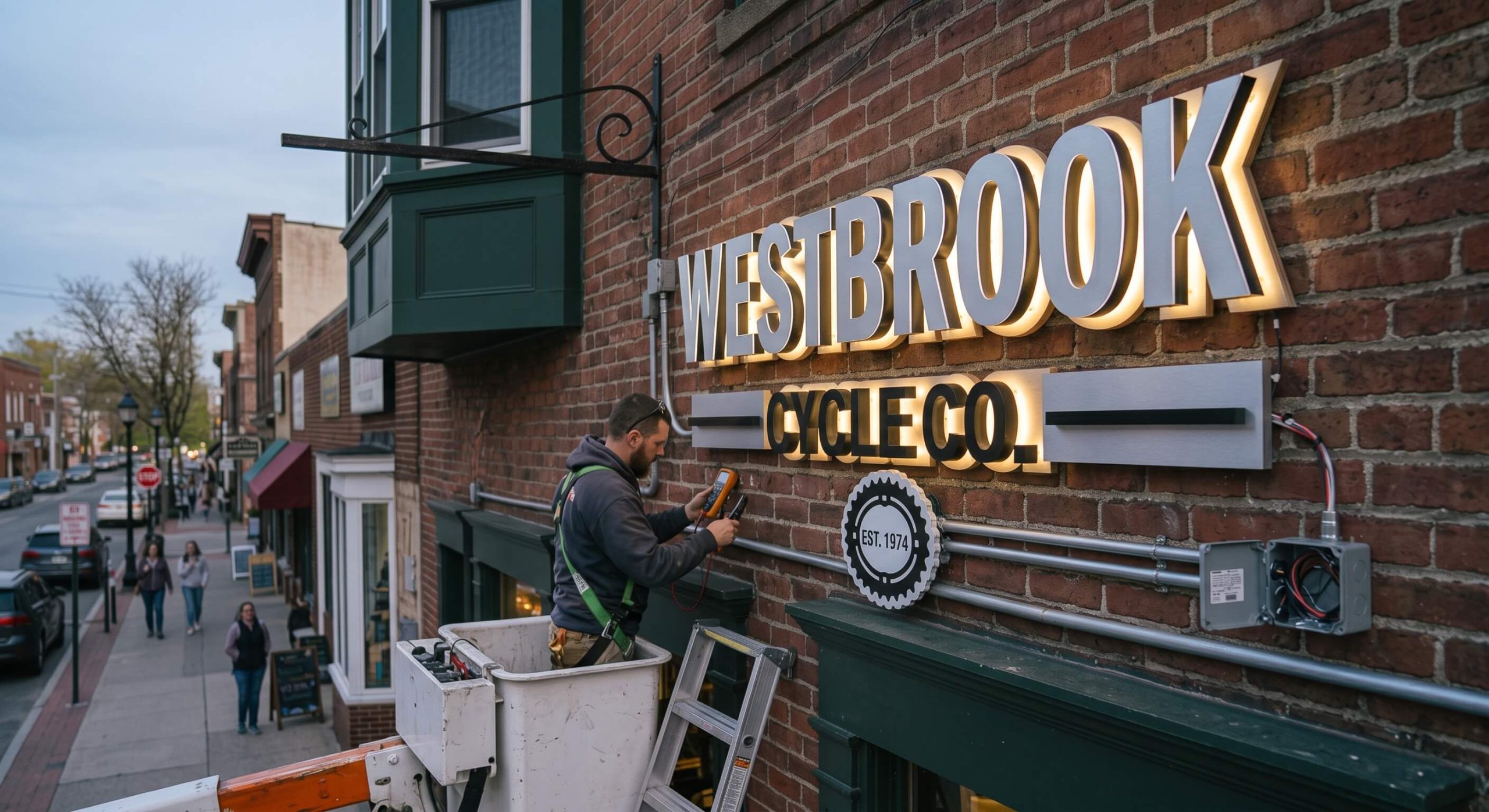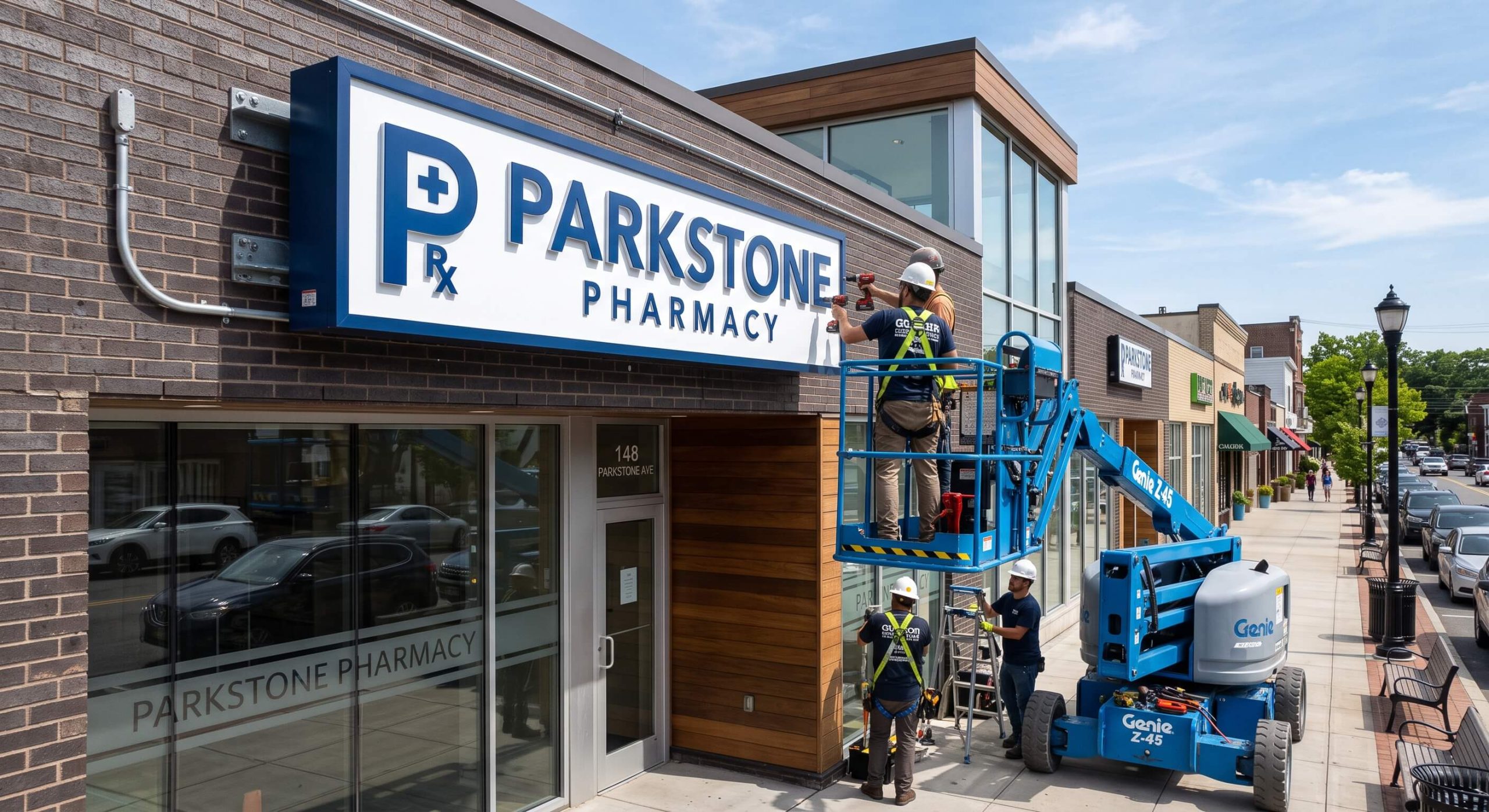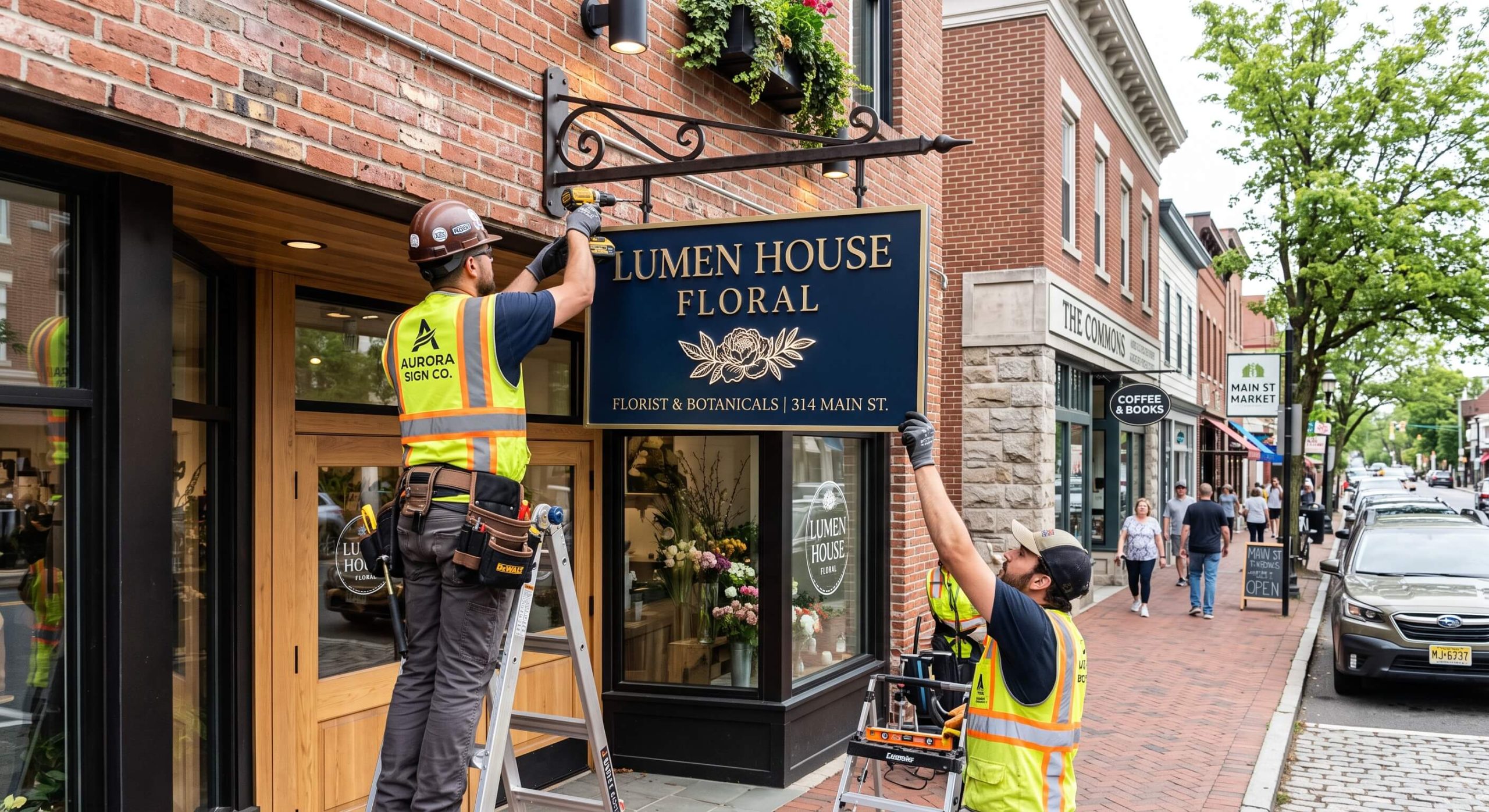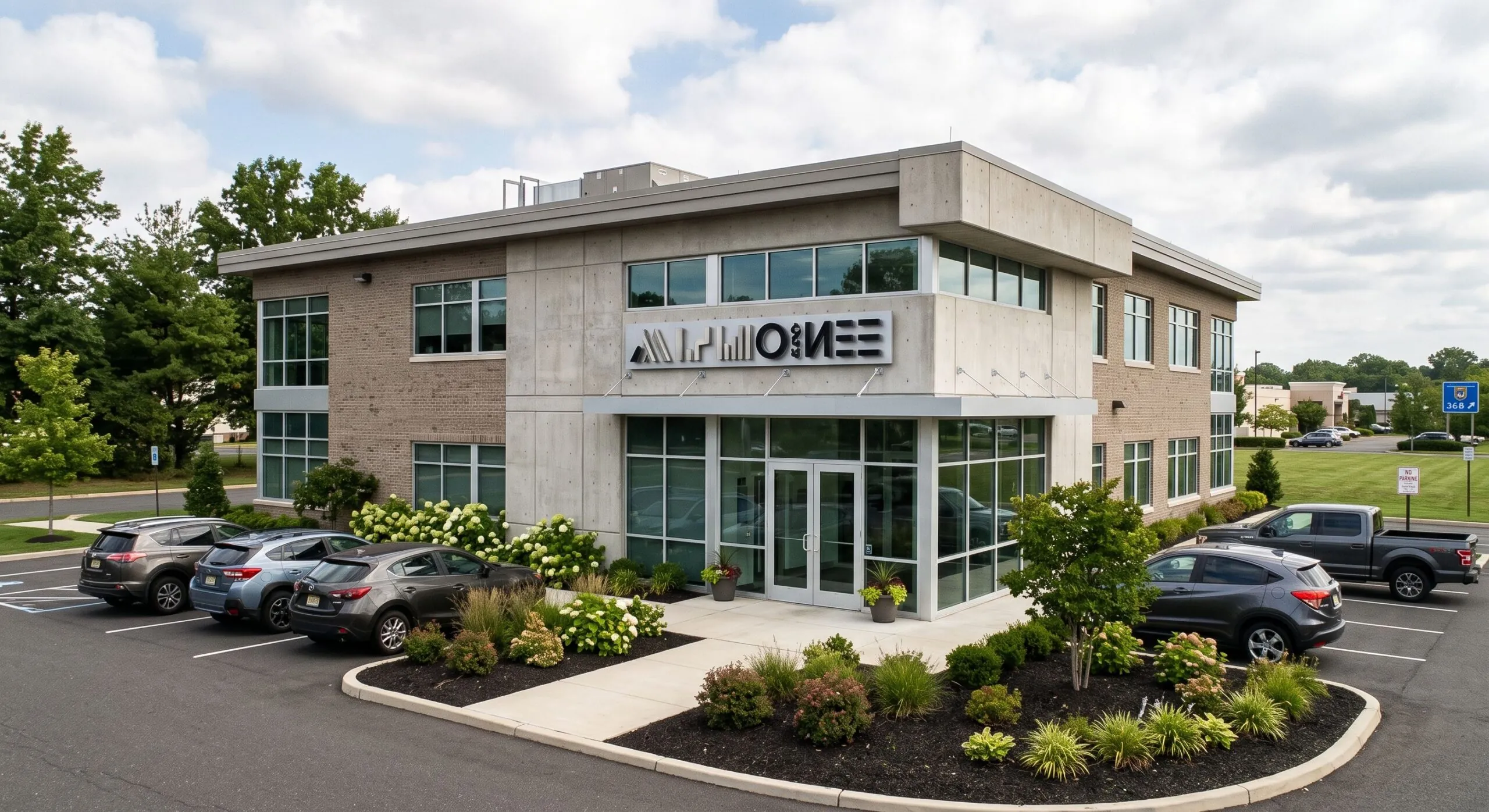
Brand recognition is often discussed as if it belongs entirely to advertising. Businesses invest in websites, social media, packaging, uniforms, and vehicles so customers will learn their name and visual identity. Commercial signs perform the same job in the place where the business operates.
A sign does more than display a logo. It connects a name to a building, a neighborhood, a service, and a customer experience. Repeated encounters make that connection easier to remember. This complements the role described in our guide to why business signage still matters in a digital world.
The effect is gradual. A person may notice a sign several times before needing the business. When that need finally arises, the familiar name has an advantage over an unfamiliar alternative.
Recognition Depends on Distinctive Cues
Customers rarely study a commercial sign in detail. They absorb a few cues: a name, color combination, letter style, symbol, building location, or overall shape.
Those cues become useful when they remain consistent. A customer who sees the same red mark on a storefront, service vehicle, and online profile does not need to relearn the brand each time. Each exposure strengthens the same association.
Consistency should not be confused with copying one layout onto every surface. A roadside monument sign has different proportions from a lobby sign. Vehicle graphics must work around doors and body lines. Window graphics compete with reflections and merchandise. Recognition comes from preserving the brand’s most identifiable elements while adapting the layout to the setting.

The Business Name Must Register Before the Details
Many commercial signs ask the viewer to process too much at once. The company name, slogan, phone number, website, service list, years in business, and promotional message are all given similar visual weight.
That approach can work against recognition. If a person cannot determine which words identify the company, repeated exposure may teach them the category without teaching them the brand. They remember seeing a sign for a dentist, contractor, restaurant, or printing company but cannot recall its name.
The identifying element needs priority. That may be the full business name, a well-known shortened name, or a symbol strongly associated with the company. A descriptor can help when the name does not explain what the business does, but it should support rather than compete with the identity.
This is particularly important for new businesses and unfamiliar brands. A nationally recognized symbol may communicate without explanation. A local company usually needs to make its name readable before expecting customers to recognize a symbol alone.
The hierarchy can change on signs viewed at close range. A reception display or window panel may include more detail because the customer has time to read it. The main exterior identifier still needs to perform in the brief moment available from the road or sidewalk.
Repetition Works When the Identity Stays Stable
Commercial signs often remain visible for years. That gives them a different role from short campaigns that appear and disappear.
A storefront sign repeatedly connects the business name with a specific destination. Fleet graphics carry the identity into job sites and neighborhoods. Interior signs reinforce it for employees, vendors, and customers already inside the property.
Problems begin when those applications drift apart. An old logo remains on the building while a new one appears online. One location uses different colors from another. Temporary banners introduce a third visual style. The business may still be identifiable, but each inconsistent version weakens the memory created by the others.
A sign inventory can reveal this drift. List the exterior signs, window graphics, vehicles, directories, reception signs, and frequently used temporary displays. Then compare how the business name, colors, logo, and terminology appear across them.
The review should include digital touchpoints as references, not as separate branding projects. A customer may see a map listing immediately before looking at the building. If the listing uses a new name while the building retains the former one, the customer encounters a recognition problem at the moment the two channels should support each other.
Location Becomes Part of the Brand
For an on-premise business, recognition is not only visual. It is geographic.
People remember the bakery near a particular intersection, the medical office inside a familiar complex, or the contractor whose trucks regularly appear in their area. The sign helps attach the name to that place.
This is why placement matters as much as artwork. A beautifully fabricated sign that is hidden by landscaping or visible only after a driver passes the entrance cannot create the same repeated impression as one positioned for the actual approach.
In busy New Jersey commercial corridors, signs compete with traffic signals, utility poles, neighboring tenants, parked vehicles, and other messages. Recognition improves when the sign has a clear silhouette, legible copy, and a stable position customers can learn over time.
The surrounding businesses also affect how distinctive a sign feels. A design can appear unique on a blank presentation page but blend into a shopping center where several tenants use similar colors, letter styles, and illuminated formats. A site survey should therefore document neighboring signs and the main approach views before the visual direction is finalized.
Distinctive does not have to mean louder. A restrained sign can stand out in a visually crowded setting because it has clearer spacing and a stronger shape. The objective is to be identifiable, not to compete through indiscriminate brightness or complexity.

A Sign System Creates More Than One Memory Point
The main building sign is usually the strongest identifier, but it should not work alone.
A customer may first see a monument sign at the road, then a tenant panel at the entrance, a window logo at the storefront, and a reception sign inside. These are separate encounters within one visit. When they follow the same visual direction, they make the business easier to recognize and navigate.
The same system can extend beyond the property:
- Fleet graphics introduce the brand throughout the service area.
- Job-site signs connect completed work with the company responsible for it.
- Event displays carry the identity into temporary locations.
- Directional signs help people recognize the brand while guiding them.
Each application should have a defined job. Adding a logo everywhere without considering message hierarchy can create clutter rather than recognition.
Growth Makes Recognition Harder to Manage
A single-location business can often maintain visual consistency informally. The owner knows which logo file is current and approves each sign personally. That approach becomes less reliable as the company adds locations, departments, vehicles, franchisees, property managers, or outside vendors.
Small variations begin to accumulate. One installer uses a color that is close but not correct. A location stretches the logo to fit a tenant panel. A vehicle receives a different service list. An interior directory shortens the business name in a way that customers do not recognize.
These changes may seem minor individually. Across a growing organization, they create several competing versions of the identity.
A practical sign standard should answer the questions that recur during production:
- Which logo arrangements are approved?
- What are the production color references for print, paint, vinyl, and illumination?
- How may the business name be shortened, if at all?
- Which descriptor or tagline is current?
- What minimum space should surround the identity?
- Which details may be removed when the available sign area is limited?
- Who approves exceptions created by a landlord or site condition?
These standards should be accompanied by usable artwork. A rule is not helpful if the manager or fabricator cannot access the correct file when a replacement is needed.
Readability Comes Before Memorability
A sign cannot build recognition if people cannot read or interpret it quickly.
Letter size, contrast, spacing, viewing distance, speed, angle, lighting, and surrounding visual noise all affect whether the identity registers. The Sign Research Foundation’s research overview emphasizes that signs are usually encountered in real environments where people are moving, distracted, or looking only briefly.
This creates a useful discipline for branded signs: protect the identifying element first. A long slogan, service list, phone number, website, and promotional message should not compete equally with the business name.
When additional information is necessary, distribute it across the sign system. Let the building sign identify the business, the window explain the offer, and the door provide hours or entry instructions.
Recognition should also be tested under the least forgiving normal condition. If a substantial share of customers arrive after dark, a daytime rendering is not enough. If the road approach places the sign at an angle, a straight-on elevation does not show the true reading condition. If trees are bare during the survey but full during the busy season, future screening needs to be considered.
Testing does not require elaborate research for every project. Scaled site photographs, distance checks, nighttime observations, and mockups placed into the actual view can reveal whether the identifying elements survive the environment.
Recognition Can Be Lost Through Neglect
A brand can be consistent on paper and still appear inconsistent in the field.
Faded print changes brand colors. Failed illumination makes part of a name disappear at night. Missing letters alter the word customers are expected to remember. Unapproved tenant notices cover planned graphics. New landscaping blocks a once-visible panel.
These are maintenance issues, but they are also branding issues. The sign is a recurring public use of the identity. Its condition influences what people repeatedly see.
At Gogi Signs, we recommend reviewing signs from the normal customer approach, not only from directly in front of the building. Day and nighttime photographs taken from those positions often reveal recognition problems that staff no longer notice.
Recognition Can Be Evaluated Without Pretending It Is a Click
On-premise signage does not produce the same reporting as a digital advertisement. That does not mean its performance must be treated as unknowable.
Start with the job assigned to the sign. If it is meant to identify a difficult location, track direction-related phone calls, missed deliveries, late arrivals, and customer comments before and after the change. If it supports a rebrand, ask customers which name they recognize and monitor whether people still use the former name. If fleet graphics are intended to build local awareness, include “saw a vehicle” as an option when asking how new customers heard about the company.
Businesses can also document changes in ordinary ways:
- Take photographs from consistent approach points over time.
- Record when landscaping, construction, or new tenant signs affect visibility.
- Ask front-line employees which signs customers mention or misunderstand.
- Compare exterior photographs on map listings with the current property.
- Note whether temporary explanations are being added to compensate for unclear identification.
These observations will not isolate signage from every other influence on the business. They do provide evidence about whether people can see, interpret, and recall the identity—more useful measures than simply asking whether the sign looks attractive.
Protect Familiar Elements During a Rebrand
Rebranding creates a tension between improvement and recognition. A business may want a cleaner, more current identity while existing customers depend on familiar colors, shapes, or wording.
Not every legacy element deserves to remain, but changing the name presentation, color palette, logo symbol, building sign, vehicles, and digital profiles simultaneously can remove all the cues customers know. A transition plan should identify which elements carry the strongest recognition and whether any should bridge the old and new systems.
Physical rollout timing matters. If the website changes weeks before the building, customers may arrive looking for an identity that does not yet appear at the property. If some locations retain the former name for months, online location pages and customer communications may need to explain the transition.
The goal is not to avoid change. It is to preserve enough continuity that customers can connect the improved identity with the business they already know.
Build a Recognizable System, Not a Collection of Signs
Commercial signs build brand recognition when they repeatedly present a clear and stable identity in the places customers encounter it. The work begins with deciding what people should remember, then protecting that cue across real viewing conditions and future applications.
That requires more than choosing an attractive sign. The business must decide which visual cues need to remain consistent, how the identity should adapt across formats, where each sign will be seen, and how the system will be maintained.
Gogi Signs has worked with New Jersey businesses since 2005 on exterior signs, interior signs, graphics, and multi-part sign programs. The strongest brand systems are rarely the ones with the most signs. They are the ones in which every sign helps customers recognize the same business.